
AISTech 2025, Nashville, Tennessee (EUA)
Optimizing Supply Chain of Plate Rolling Mill Process: A Digital Twin System
Gêmeo Digital que monta as sequências de laminação de chapas (coffins) respeitando as restrições logísticas e operacionais, com sequências 12% maiores que as montadas manualmente.
Aplicação prática na indústria (Programação do laminador de chapas)
O laminador de chapas precisa entregar cada chapa na data certa, mas só pode laminar placas disponíveis e compatíveis entre si. O artigo monta automaticamente as próximas sequências de laminação (coffins).
Do conceito matemático ao ganho de negócio
- Sequenciamento com restrições de compatibilidade
- Placas consecutivas precisam ter tipo de aço, temperatura, espessura e largura próximos; o gêmeo monta sequências que respeitam isso por construção.
- Disponibilidade de placas
- Só entra na sequência a placa que estará disponível a tempo, o que liga o laminador ao estoque e à logística interna.
- Minimização de atrasos
- Entre as sequências viáveis, o gêmeo busca a que reduz o atraso das demandas.
Resultado: As sequências montadas pelo Gêmeo Digital foram, em média, 12% maiores que as montadas manualmente.
Resumo executivo da Enacom, em português, a partir do artigo e dos projetos relacionados.
Resumo
O laminador de chapas tem um processo de programação complexo, com muitas restrições logísticas e operacionais, e precisa produzir as chapas na data de entrega correta para o cliente final. Entre essas restrições estão a disponibilidade da placa a ser laminada e os parâmetros que duas placas consecutivas devem compartilhar ou ter com valores próximos, como tipo de aço, temperatura, espessura e largura. Nesse sentido, foi desenvolvido um sistema de Gêmeo Digital que monta as próximas sequências de laminação (coffins) respeitando todas as restrições operacionais e logísticas, ao mesmo tempo em que procura minimizar o atraso nas demandas. Os coffins criados pelo Gêmeo Digital são, em média, 12% maiores e incluíram 1% mais demandas atrasadas do que os criados manualmente.
Resumo traduzido do original, publicado em inglês.
Artigo completo
Texto completo do artigo, em inglês. Versão apresentada no ABM Week 2024 (26º Seminário de Automação e TI, São Paulo, 3 a 5 de setembro de 2024); pode diferir da versão publicada nos anais do AISTech 2025.
1 Introduction
The optimization of processes in large scale industrial plants is fundamental to ensure high levels of productivity, and to minimize the occurrence of undesired scenarios [1]. In the field of steel production, computer-assisted optimization has proven to be of great benefit to different steps in the manufacturing of steel products [2]. In particular, the technology of digital twins is widely employed in optimization tasks in several industries [3], and the benefits of its usage in steel production are well documented, leading to increases in productivity and a higher level of predictability in the supply chain [4].
Rolling mills are steel processing plants used to refine certain products into more usable forms [5]. They receive products manufactured by casting machines and apply rolling cylinders and cutting devices to reshape and split them [6]. The necessity to optimize operation scheduling in a rolling mill arises naturally from the desire to maximize production, minimize wearing of machine parts, and avoid delays in product deliveries. In this paper, we present a solution to the scheduling problem of the Gerdau rolling mill in Ouro Branco [7].
The rolling mill this work is based on receives steel slabs as its raw material and produces steel plates as the final product. Its process starts with the reheating of input slabs, which are then rolled into the desired thickness by rolling cylinders, becoming steel roughs. The roughs then undergo cooling and leveling, before being cut into a series of plates and moved to a storage yard for later distribution after its careful inspection. Figure 1 contains a high-level schematic of the rolling mill as described.
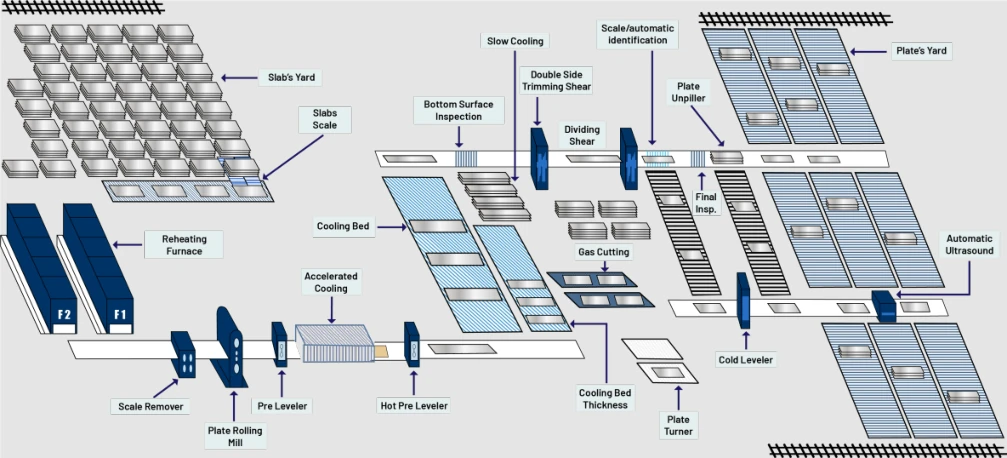
The working roll cylinders in the rolling machine sustain wear after every operation, which means they must be replaced constantly after processing a certain set of slabs. A list of scheduled slabs to be rolled consecutively with the same working cylinders is called a coffin [6]. The mill, therefore, operates one entire coffin at a time, before undergoing a cylinder change for the next coffin.
The scheduling algorithm employs heuristic methods, combined with digital twin technology. The main benefit of using a digital twin is that it executes a moment-to-moment simulation of the rolling mill based on the current data, providing useful information for every step of the process, including data on storage occupation, resource availability, and key performance indicators (KPI), to assist in the task of decision-making by the operational and supply chain departments [4].
2 Discussion
2.1 Problem Definition
In the sequence, a high-level description of the scheduling problem solved by the algorithm is presented. It starts with a description of the problem’s input and output, followed by the objective function and restrictions.
2.1.1 Input and Output
The problem’s input, in simple terms, is a list of pending steel rolling demands and parameters related to operational restrictions. It includes information such as:
- Rolling demands:
- Either already associated with a slab in the storage yard, or requiring a slab that has yet to be cast by the steel mill.
- Current storage yard status:
- Listing slabs and plates in the plant’s yards.
- List of planned unavailabilities of the rolling mill:
- Periods in which the mill will stay idle for maintenance or routine checkups.
Given the input information, the algorithm selects demands to be processed, schedules the rolling of the demands into a timeline, and provides a step-by-step simulation with the digital twin.
The output of the algorithm contains the scheduled demands separated into coffins, as described in the introduction. Several rules and restrictions apply to the construction of proper coffins, which will be better detailed in Subsection 2.1.3.
The output of the algorithm contains:
- A list of coffins ordered by starting time.
- Every coffin contains a list of demands, also ordered by starting time.
- Unallocated demands, including:
- Rejected demands: valid demands that were not allocated in any coffin;
- Invalid demands: demands with some pending parameters to be manually evaluated by the user.
- Simulation data, including:
- Start and end time of every demand’s processing;
- List of constraints broken by solution;
- Amount of steel rolled per day;
- Data on delayed demands;
- Status of each sale order;
- Occupation in the plate yard and in the intermediate buffers.
2.1.2 Objective Function
Every demand has a specific due date by which it must have its plates in the yard (already approved), and the objective of the optimization problem is to minimize this delay.
2.1.3 Main Restrictions
In this subsection, an overview of the problem’s most relevant restrictions is presented. Specific details are omitted for the sake of brevity.
Hard Restrictions
The hard restrictions for the scheduling problem pertain to coffin construction and time allocation. Coffin construction, in particular, is the main focus of the algorithm.
- Coffin Stages
- The demands that compose a coffin can be partitioned into stages. For a slab to be eligible for a stage, it must be inside the allowed parameter intervals for the stage, which include:
- Minimum and maximum width and thickness.
- Allowed resistance classes.
- Furthermore, stages in a coffin must also verify other restrictions, including the following:
- Every stage is associated with a list of possible next stages, listing the stages that can follow it. The last slab in each stage must necessarily be followed by a slab from a stage in the list.
- Stages have a maximum and minimum number of slabs they must contain.
- There exists a maximum negative and maximum positive width delta parameter for every stage, determining how much the width between two consecutive elements in a stage may vary.
- Coffins must always start in a special stage called the opening stage. The parameters for that stage determine the kinds of demands a new set of working roll cylinders must start with.
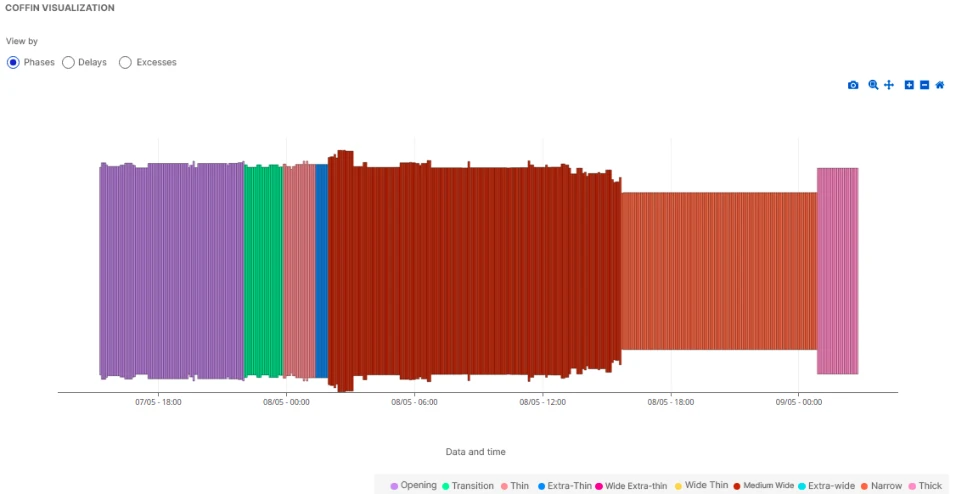
- Figure 2 contains an example of a coffin partitioned into stages.
- The demands that compose a coffin can be partitioned into stages. For a slab to be eligible for a stage, it must be inside the allowed parameter intervals for the stage, which include:
- Unfurnacing Temperature
- Every demand has a parameter that determines to what temperature their corresponding slab must be reheated before rolling, called the unfurnacing temperature. It is imperative that slabs with the same unfurnacing temperature are done consecutively in a coffin, to avoid gaps in the furnace and enable better efficiency of its usage.
- Demand Processing Times
- The processing time of a given demand depends on several factors, including its width, the number of times it must be rolled before it is in the desired thickness, the cutting process it must undergo, and the transit times between different machines in its processing route.
- Unavailability of Machines
- During certain time intervals, machines within the mill may be unavailable, due to maintenance or routine checkups. During these intervals, demands that depend on the machine cannot be processed.
- Working Roll Cylinder Change Time
- Between the end of one coffin and the beginning of the next, there must be an idle period for the change of roll cylinders in the rolling machine.
- Hard Parameter Grouping
- For some demand parameters, there is a number n such that demands with the same value on the parameter must be placed in consecutive groups of at least n slabs within a coffin. Examples include:
- Steel family: steel types with similar rolling routines;
- Rolling strategy: defines whether the slab uses normal or controlled rolling.
- For some demand parameters, there is a number n such that demands with the same value on the parameter must be placed in consecutive groups of at least n slabs within a coffin. Examples include:
Soft Restrictions
Soft restrictions are not necessary for a solution to be considered acceptable, but desirable to make solutions that are better aligned with the attendance of the final client and promote a better functioning of the rolling mill and its plant (other equipment and processes included).
- Avoiding Short Coffins
- A coffin whose number of slabs is below a given minimum value is considered short. Short coffins are undesirable, as they incur more cylinder changes for smaller amounts of processed slabs.
- Soft parameter grouping
- Some less critical parameters such as rolling way and slab width should be grouped when possible, but can be made separated in case of conflict with some more important parameter.
2.2 Main Algorithm

The main components of the algorithm, as shown in Figure 3, are the pre-processing routine, the coffin construction, and the temporal simulation. The last step characterizes the system as a digital twin, providing detailed information for the decision-making process by simulating the processing of the scenario, and calculating valuable metrics over the solution.
Prior to the simulation and metrics, the most fundamental component of the algorithm is the coffin construction. Constructing adequate coffins is fundamental for the better functioning of the rolling mill. Subsection 2.2.1 explains the coffin construction in more detail.
2.2.1 Coffin Construction
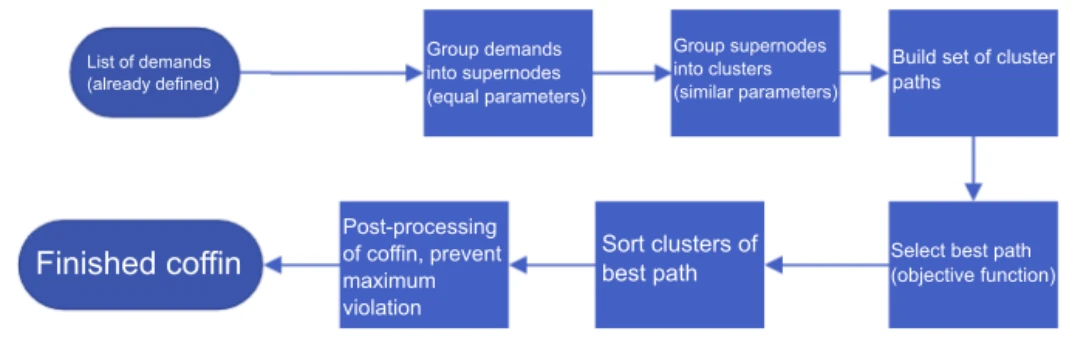
The construction of coffins uses graph theory heuristics to build large coffins in a reasonable amount of time.
It starts by grouping available demands into sets we call clusters. Clusters are sets of demands that have similar or equal values in certain parameters, including:
- Unfurnacing temperature.
- Earliest possible stage.
- Rough's width.
- MULPIC strategy.
The algorithm uses a simple recursive method to search for the best directed path of clusters. A path is an ordered sequence of clusters which respects the following rules for gradual path composition, starting with an empty path:
- If the current path is empty, select a cluster that is eligible for the opening stage and add it to the path. Set that cluster’s stage to opening.
- If the current path is not empty, let C be its last cluster, and S the stage of C. Let C’ be another cluster that does not belong to the path. Cluster C’ can be added after C in the path if:
- The possible stages for C’ include at least one stage that can follow S;
- The addition of the slabs in C’ after the slabs of C in a coffin do not violate any hard restrictions;
- If S is not a possible stage for C’, then the sum of lengths of the clusters set to stage S in the current path must be at least the minimum number of demands determined for stage S.
The objective function for the paths is composed of a priority list of several elements, including:
- Number of remaining unallocated late demands (i.e. late demands that are not in any coffin, nor within the clusters of the current path);
- Number of unallocated timely demands (a demand is timely if its due date is close to the current time);
- Difference between sum of cluster sizes and desired slab amount in a coffin.
Once the recursive method returns the best path found, its clusters are reordered according to a priority list of stages. After that, a new coffin is constructed. The construction of the coffin starts by adding every demand from every cluster into a new, initially empty coffin, in the order given by the path.
Afterwards, a post-processing routine adjusts the coffin to ensure no hard restrictions are broken. The most important step in the post-processing is removing demands from the coffin if their selected stage already exceeds the maximum amount determined for the stage.
Finally, the new coffin is inserted into the timeline, with the help of the temporal simulation algorithm. The starting time for the next coffin is then calculated.
2.3 Experimental Results
The software is currently being used by the supply chain team in the routine to define the next coffins to be produced. The current section shows an analysis considering a comparison between coffins that were constructed with the aid of the digital twin, and coffins constructed manually (using the "as is" strategy, before the system implementation).
| Metric | Digital twin | Manual execution |
|---|---|---|
| Number of coffins | 3 | 11 |
| Average number of slabs per coffin | 391.67 | 281.18 |
| Average number of broken restrictions | 3.33 | 2.36 |
| Average percentage of late demands in coffin | 55% | 30% |
| Average percentage of on time demands in coffin | 13% | 13% |
| Average percentage of anticipated demands in coffin | 32% | 56% |
| Metric | Digital twin | Manual execution |
|---|---|---|
| Number of coffins | 10 | 8 |
| Average number of slabs per coffin | 328 | 294 |
| Average number of broken restrictions | 3.27 | 4.13 |
| Average percentage of late demands in coffin | 26% | 23% |
| Average percentage of on time demands in coffin | 11% | 12% |
| Average percentage of anticipated demands in coffin | 43% | 48% |
Some conclusions can be drawn from the two tables above. The first thing is that the coffins generated using the digital twin have more slabs on average, this allows better cylinder usage and less operational time taken to swap the cylinders, allowing the rolling machine to work more time. Making an estimation considering the average roll change time of 25 minutes, and the average productivity of the rolling mill, a total addition of 222.54 tons could be produced in a month (considering March's data).
Another matter that the data shows is about the due date optimization, resulting in coffins with a higher percentage of late demands being produced.
The last topic is about the average number of broken restrictions, as there was an increase in March and a decrease in April. Considering that the goal of the system is to avoid unnecessary broken restrictions, March results were unsatisfactory, but due to improvements made in the algorithm and in the system utilization (including a considerable increase in the user utilization, reflected in the better relation of coffins made manually and with the digital twin), a better result was achieved in April, with less restrictions broken. This reduction enables better coffin production, resulting in plates with more quality at the end of the process, therefore less products that need to be reprocessed.
2.4 System's Capabilities
2.4.1 Optimization Results Screen
The optimization result screen focuses on providing useful information about the solution to the optimization problem, including detailed data on the simulated execution of the scenario.
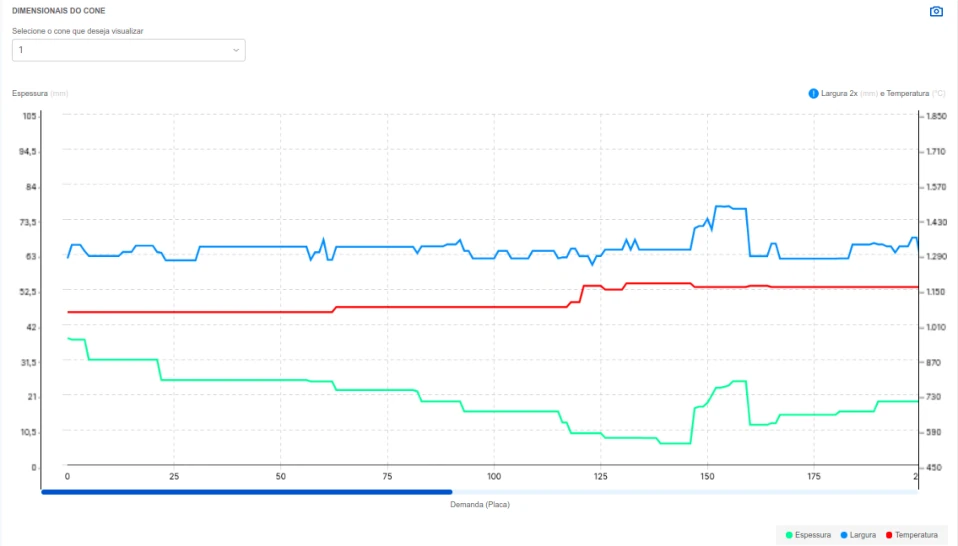
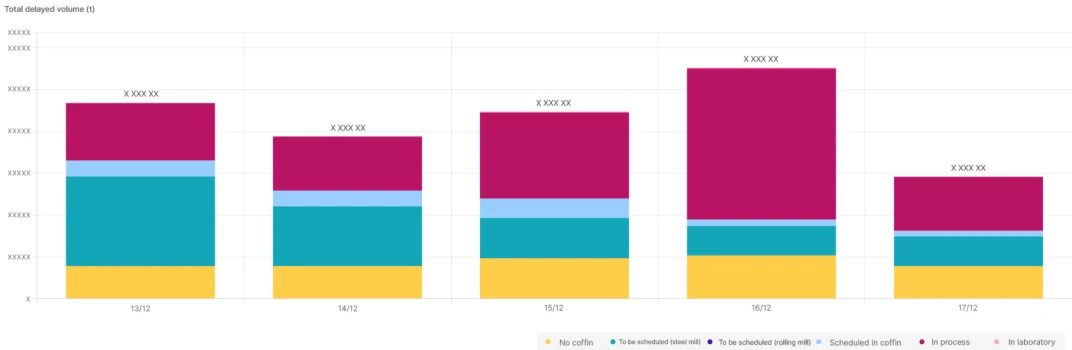
Figure 2 contains a screenshot of one of the optimization result screens provided by the digital twin system. It includes a timeline with the slabs of each coffin. Figure 5 contains another screenshot, showing the evolution of the unfurnacing temperature, width and thickness of demands in a coffin. On the topic of KPIs, Figure 6 shows one of the main ones. It informs the expected tons of delay for each day of the scenario, as well as details of where this delay is happening.
Other screens exist with more information but were omitted for brevity.
2.4.2 Integration of Existing Systems
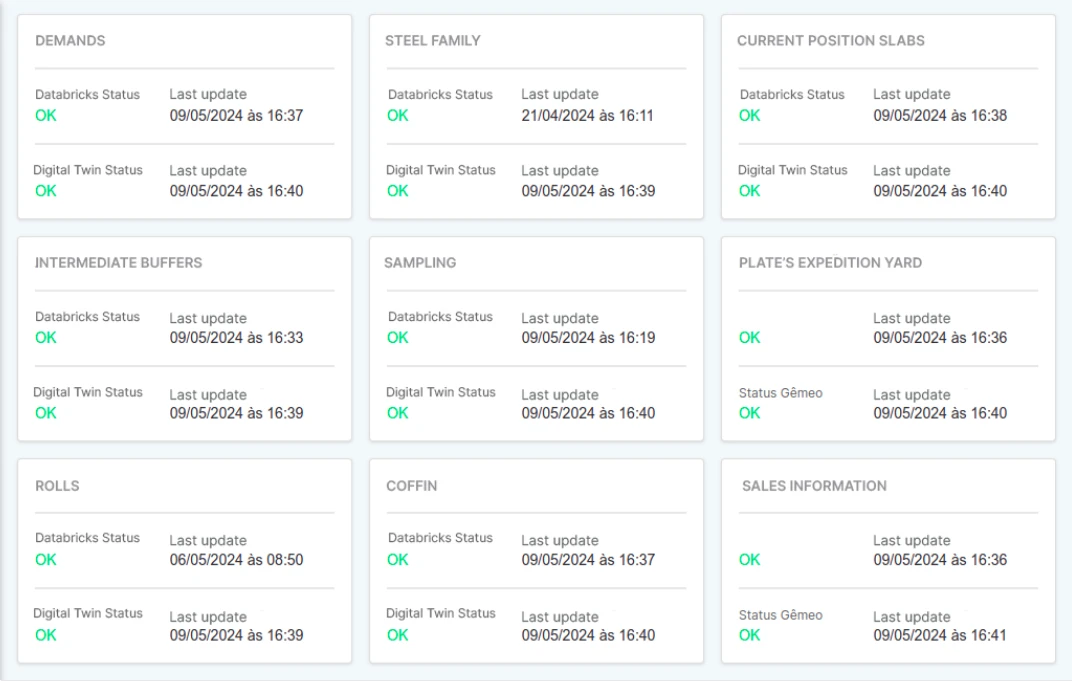
The GERDAU steel plant from the city of Ouro Branco uses several different systems to keep track of the plates in its yard, steelworks outputs, and rolling mill demands, which often work independently from one another. Figure 7 shows a tab from the software with the integration of the systems that send data to the digital twin.
Before the implementation of the current digital twin system, the interface between those systems was limited, which led to some disruptions in the supply chain, such as overproduction of certain demands, and surplus plates being left idle in the distribution yards without ever being allocated into a sale item. Thanks to the system’s better integration, 25 excess pieces weren’t produced in the interval of 3 months.
3 Conclusions
The digital twin system, and the solution algorithm implemented within it, enable better decision making on the part of the rolling mill production planners. The coffin construction algorithm can check a plethora of different restrictions while providing large coffins and aiming to minimize delivery delays to the final client, empowering better productivity and keeping the supply chain functional.
Furthermore, the digital twin provides the user with a full report of its simulated execution, including a timeline of processed demands, and several performance indicators, allowing an analysis of multiple production scenarios to aid in the decision-making process.
The information provided by the system is also currently used to avoid overfilling of storage yards, and overproduction of plates when not necessary, resulting in an improvement in space, time, and resource efficiency.
Future works include the implementation of new restrictions and objectives, such as aiming for hot furnacing, as well as applying digital twin technologies and optimization algorithms to other rolling mills, considering the particularities of each one. Besides that, allowing a thorough integration of the system with other digital twin systems in the same plant. For example, a communication between this system and a previously implemented steel mill digital twin [8].
Acknowledgments
This work was the consequence of an ENACOM project in association with Gerdau. Besides those, the authors thank the support of FAPEMIG and CNPQ.
References
- Schulz J. Applying Mathematical Optimization in Practice. Operations Research Forum, 2021;2(1):1-12. Available in: https://doi.org/10.1007/s43069-020-00046-9.
- Xu ZJ, Zheng Z, Gau XQ. Operation optimization of the steel manufacturing process: A brief review[J]. Int. J. Miner. Metall. Mater., 2021;28(8):1274-1287. Available in: https://doi.org/10.1007/s12613-021-2273-7.
- Javaid M, Haleem A, Suman R. Digital Twin applications toward Industry 4.0: A Review. Cognitive Robotics, 2023:71-92. Available in: https://doi.org/10.1016/j.cogr.2023.04.003.
- Zhang Y, Sukhram M, Cameron I, Rozo A. Industrial Perspective of Digital Twin Development and Applications for Iron and Steel Processes. AISTech 2020 Conference Proceedings, March 2021:34-43.
- Grajcar A. (2021). Researches and Simulations in Steel Rolling. Metals, 2021;11(560): 1-3. Available in: https://www.mdpi.com/2075-4701/11/4/560.
- Özgür A, Uygun Y, Hütt MT. A review of planning and scheduling methods for hot rolling mills in steel production. Computers & Industrial Engineering, 2021;151:1-16. Available in: https://doi.org/10.1016/j.cie.2020.106606.
- Fraga RA, Alves RP, Freitas FV, Reis EG, Pereira MM, Silveira JHD. The New Gerdau Plate Mill. Proceedings of the 53rd ABM rolling seminar, 2016;53(53):253-262. Available in: https://doi.org/10.5151/1983-4764-27697.
- Campos PHF, Tamantini TBF, Amaral IFS, Mendonça MO, Silva GRL, Duarte GJ, et al. Production Scheduling Optimization for the Steelmaking. Proceedings of the 24th ABM automation and IT seminar, 2022;24(24):203-216. Available in: https://doi.org/10.5151/2594-5335-34923.
Quer conversar sobre o que leu?
Conte o desafio da sua operação e nossa equipe avalia com você por onde começar.