
AISTech 2026, Pittsburgh, Pensilvânia (EUA)
Digital Twin for Profile Rolling Mill Sequencing Based on Inventory Risk and Roll Chance Productivity
Dois Gêmeos Digitais que sequenciam pedidos da laminação de perfis por viabilidade de estoque, risco de ruptura e urgência de exportação, sem aumentar as trocas de cilindros.
Aplicação prática na indústria (Sequenciamento de campanhas na laminação de perfis)
Cada troca de cilindros para a linha de perfis, e a carteira é diversa. O artigo sequencia as campanhas a partir do estoque real, para aproveitar os cilindros sem deixar faltar perfil com pedido em aberto.
Do conceito matemático ao ganho de negócio
- Sequenciamento com risco de ruptura
- A ordem das campanhas considera o estoque atual e o risco projetado de faltar cada perfil.
- Agrupamento de perfis compatíveis
- Blocos de pedidos que aproveitam ao máximo cada conjunto de cilindros, com menos trocas de gaiola.
- Priorização por urgência de exportação
- Pedidos de exportação com prazo apertado sobem na fila sem desmontar a campanha.
Resultado: No case relacionado, o sequenciamento dinâmico reduziu as trocas de gaiola em 13,5% por mês, em média, em quatro meses de operação em uma Mini-Mill; em uma usina integrada, a produção seguiu 80,5% do volume planejado no bimestre medido.
Ver o case: Laminação de perfisAplicações em Siderurgia
Resumo executivo da Enacom, em português, a partir do artigo e dos projetos relacionados.
Resumo
As linhas de laminação de perfis precisam atender a um portfólio diversificado de pedidos, minimizando as trocas de cilindros e evitando a falta de material. Os dois frameworks de Gêmeo Digital apresentados neste trabalho tratam o complexo problema de sequenciamento por meio de três direcionadores principais de decisão: a viabilidade do estoque atual, o risco projetado de ruptura e a urgência dos pedidos de exportação. O motor de sequenciamento seleciona blocos de pedidos que maximizam a utilização dos cilindros, agrupando perfis compatíveis e equilibrando as prioridades de demanda. A integração com os dados de estoque permite ajustes proativos que evitam rupturas sem aumentar a frequência de trocas de cilindros. Os frameworks oferecem aos planejadores recomendações transparentes, que alinham a eficiência operacional aos objetivos de atendimento ao cliente.
Resumo traduzido do original, publicado em inglês.
Palavras-chave
Digital TwinOptimizationProfile Rolling MillInventory RiskSequencing
Artigo completo
Texto completo do artigo, em inglês.
Introduction
Achieving elevated productivity levels and mitigating unfavorable operational scenarios depends heavily on the optimization of processes within large-scale industrial facilities1. In steel manufacturing, the implementation of computer-assisted optimization has demonstrated significant advantages across various production stages2. Specifically, digital twin technology has been extensively adopted for optimization purposes in diverse industrial sectors3, and the benefits of its usage in steel production are well documented, resulting in enhanced production throughput and improved supply chain predictability4.
Profile rolling mills are specialized steel processing facilities that transform beam blanks and blooms into structural profiles through a sequence of rolling operations. These mills receive semi-finished products manufactured by casting machines and apply sets of rolling cylinders arranged in tandem or breakdown configurations to reshape them into the desired cross-sectional geometries. The necessity to optimize operation scheduling in a profile rolling mill arises naturally from the desire to maximize production throughput, minimize roll change frequency and its associated downtime, and avoid material shortages that could disrupt delivery commitments.
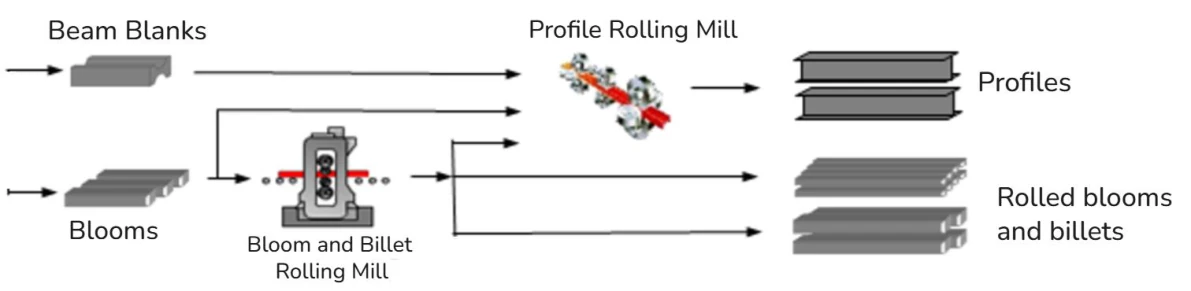
The profile rolling mills analyzed in this work receive steel blooms, beam blanks, and billets as raw materials and produce structural profiles as the final product. The process begins with the heating of input material, which is then rolled into the desired profile shape by sets of working rolls arranged in tandem and breakdown positions. The profiles undergo gauge measurement between campaigns and may require channel adjustments when processing different gauge families. Throughout the process, the working rolls sustain wear and must be replaced periodically after processing compatible profile sequences. The finished profiles are then moved to storage yards for inspection and later distribution. A group of profiles rolled consecutively with the same roll configuration is called a campaign.
The sequencing engines within both frameworks utilize heuristic logic, detailed in the Discussion section, to harmonize production efficiency with inventory health through digital twin technology. The primary advantage of this digital twin integration is its ability to perform continuous, real-time simulations of the rolling mill's behavior relative to current warehouse levels and export deadlines. By synthesizing data on material compatibility and demand urgency, the systems provide a granular view of resource availability and stockout indicators, serving as a critical decision-support tool for the supply chain department to optimize campaign lengths while mitigating the risk of unfulfilled orders.
Discussion
1. Problem Definition
The profile rolling mill sequencing problem revolves around the construction of production campaigns by deciding which profiles will be included in each campaign, and in which order the profiles must be rolled. The process must consider both logistical constraints, such as demand due dates, inventory availability, and stockout risk, as well as physical and technical ones, such as profile family compatibility, gauge transitions, roll consumption limits, feedstock material restrictions, and scheduled downtimes.
In the sequence, a high-level description of the sequencing problem solved by the algorithm is presented. It starts with a description of the problem's input and output, followed by the objective function and restrictions.
1.1 Input and Output
The problem's input, in simple terms, is a list of pending profile production demands and parameters related to operational restrictions. It includes information such as:
- Dependent needs: Profile orders requiring fulfillment, either already associated with available crowned steel inventory or requiring feedstock that has yet to arrive or be processed.
- Current inventory status: Integrates comprehensive data for both raw and intermediate materials. This includes the steel stock inventory, which tracks available feedstock such as blooms and billets with details on material types, SKUs, amounts, and arrival dates, as well as the crowned steel inventory, which lists intermediate products ready for final rolling operations.
- Roll inventory: Information about tandem rolls and BD rolls available in the workshop, including their current usage state and remaining capacity.
- List of planned downtimes: Contains scheduled maintenance for the rolling line and specific resources, alongside unscheduled downtime parameters that account for operational inefficiencies.
- Campaign configuration parameters: Include roll consumption limits categorized by family and campaign type alongside channel limits for conventional rolling configurations. Additionally, these parameters define both soft and hard limits for minimum campaign durations, establish required chair change and gauge measurement times, and incorporate feedstock lead times to facilitate accurate material arrival planning.
- Family and gauge priorities: Operational priorities assigned to different profile families and gauges to guide sequencing decisions.
- Export order flags: Identification of export orders that require priority treatment.
Given the input information, the algorithm selects profiles to be processed, groups them into campaigns, schedules the rolling sequence into a timeline, and provides a step-by-step simulation with the digital twin.
The output of the algorithm contains the scheduled campaigns ordered by starting time. Every campaign contains a list of profiles, also ordered by processing sequence. Several rules and restrictions apply to the construction of proper campaigns, which will be better detailed in Subsection 1.2.
The output of the algorithm contains:
- A list of campaigns ordered by starting time: Every campaign contains a list of profiles, also ordered by starting time within the campaign.
- Rejected campaigns: Valid campaigns that were not allocated due to feedstock unavailability, duration constraints, exceed roll consumption capacity or other hard restrictions.
- Simulation data: Overview of the process by recording the precise start and end times for both individual profile processing and overall campaigns. It incorporates the full list of constraints used in the solution alongside temporal tracking of steel and crowned stock levels. Additionally, the data captures roll consumption and selection sequences for rolls, logs the timing of channel and cage change events, and documents downtime handling, including instances where profiles are split due to production interruptions.
1.2 Hard Restrictions
The hard restrictions for the sequencing problem pertain to campaign construction and time allocation. Campaign construction is the focus of the algorithm.
Campaign Construction
- Family grouping: All profiles within a campaign must belong to the same family. Profile families represent groups of profiles with compatible rolling parameters and similar production requirements.
- Roll consumption limits: Each campaign type has specific roll consumption limits that must not exceed. These limits are applied differently depending on the campaign structure, where unique campaigns process profiles with a single gauge, while mixed campaigns are designed to process multiple gauges within the same product family.
- Roll channel limits: When processing profiles in conventional rolling mode, roll channels have capacity limits. Once a channel reaches its limit, a channel change downtime must be scheduled before continuing with compatible profiles.
- Minimum campaign duration: Every campaign must meet a hard minimum duration requirement. Campaigns that cannot achieve this minimum duration due to insufficient profiles or other constraints are rejected.
- Feedstock material sequence restrictions: Small blooms cannot be followed by big blooms in consecutive campaigns. This restriction prevents inefficient material transitions that would require additional setup time. Beam blanks and big blooms have specific sequencing rules when both material types are present in the order portfolio.
- Feedstock availability: For each profile in a campaign, the required feedstock material must be available in the steel stock inventory at the time of production, considering feedstock lead times for material arrival.
- Conventional campaign spacing: When processing conventional campaigns, a minimum number of days must elapse between consecutive conventional campaigns to allow for equipment preparation and maintenance.
- Chair type transitions: The time required to change between different chair and cage types must be accounted for in the temporal simulation.
- Gauge transitions: When profiles with different gauges are processed within the same campaign or in consecutive campaigns, gauge measurement time must be allocated. This time is added between profile processing or between campaigns.
- Downtime restrictions: During scheduled rolling line downtimes, no production can occur. During resource-specific downtimes, certain resources may have scheduled downtimes. Depending on the resource and family combination, production may be allowed or disallowed during these periods.
- Unscheduled downtime impact: The use factor calculation considers unscheduled downtime parameters (operational stops, maintenance, etc.) which affects the effective production time available for campaign processing.
1.3 Soft Restrictions
Soft restrictions are not necessary for a solution to be considered acceptable, but desirable to make solutions that are better aligned with customer service and promote better operational efficiency.
- Family continuity: Maintaining the same family in consecutive campaigns is desirable to minimize family change overhead, though not always feasible due to demand diversity.
- Gauge continuity: Maintaining the same gauge between consecutive profiles or campaigns reduces gauge measurement time and improves production flow, though gauge transitions are often necessary to satisfy the order portfolio.
- Stockout risk mitigation: Profiles with high stockout risk (calculated based on billed stories, current crowned inventory, and demand balance) should be prioritized to prevent inventory shortages that could delay customer deliveries.
- Export order prioritization: When export prioritization is active, campaigns containing export orders should be scheduled earlier to ensure on-time delivery for international customers.
- Family priority respect: When possible, campaigns from higher-priority families should be scheduled before lower-priority ones, aligning production with strategic business objectives.
- Roll utilization optimization: Campaigns should be constructed to maximize roll utilization within their consumption limits, reducing the frequency of roll changes and associated downtime.
1.4 Temporal Simulation Restrictions
Besides the restrictions on campaign assembly, the digital twin temporal simulation of the system also must follow a set of hard restrictions, independent of the campaign construction procedure:
- Profile processing times: The processing time of a given profile depends on several factors, including the total quantity, profile yield (the ratio of output to input material), rolling productivity (tons per hour), and the utilization factor. The calculation integrates these parameters to determine the actual rolling duration in minutes. Additionally, between consecutive profiles, it is necessary to account for gauge change times as well as channel/cage change times, which occur when a roll channel reaches its capacity limit or when profiles require an incompatible channel.
- Campaigns processing times: Between campaigns with different chair types (Universal/Conventional transitions), or when performing URS changes within Universal configurations, a chair change time must be allocated. The specific time depends on the origin and next chair types.
- Unavailability of machines: During certain time intervals, machines within the mill may be unavailable due to maintenance or routine checkups. During these intervals, profiles that depend on the affected resources cannot be processed. When a downtime overlaps with a profile processing window, the profile may be split into segments processed before and after the downtime.
- Feedstock consumption simulation: As campaigns are scheduled, the steel stock inventory is decremented to reflect material consumption. This simulation ensures that feedstock availability constraints are respected throughout the planning horizon.
- Crowned stock simulation: As profiles are produced, the crowned stock inventory is incremented, and as demands are fulfilled, it is decremented. This simulation enables stockout risk assessment and proactive inventory management.
2. Main Algorithm
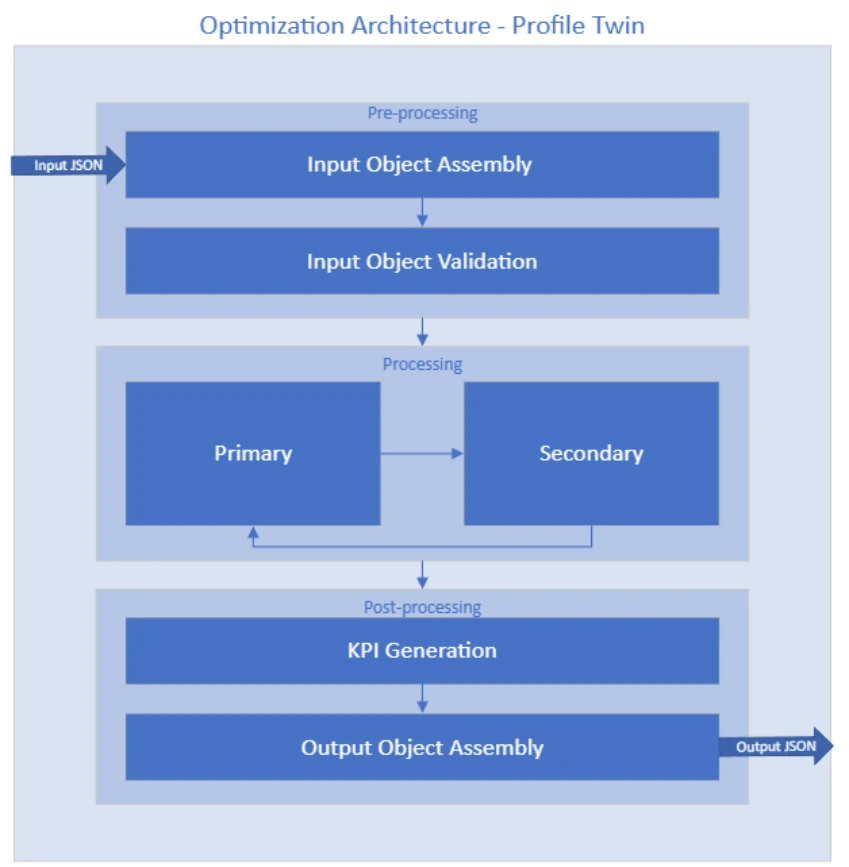
The main components of the algorithm, as shown in Figure 3, are the pre-processing routine (input assembly and validation), the processing routine (primary optimization problem and secondary roll workshop optimization), and the post-processing routine (KPI generation and output assembly). The temporal simulation component characterizes the system as a digital twin, providing detailed information for the decision-making process by simulating the processing of the scenario and calculating valuable metrics over the solution.
2.1 Pre-processing Routine
The pre-processing stage is responsible for transforming the raw JSON input data into validated, structured objects that can be processed by the optimization algorithm. This stage consists of two main steps: input assembly and input validation.
The input assembly step transforms the raw JSON input into an object containing all necessary information for optimization. This process integrates campaign configurations, process and machining times, and dependent customer needs alongside comprehensive inventory structures for steel stock, crowned products, and roll capacity, ensuring all necessary variables are consolidated for the optimization engine.
The input data is validated against a JSON Schema definition to ensure data integrity, required fields presence, and correct data types before proceeding to optimization.
2.2 Processing Routine
The processing routine is the core of the optimization algorithm and consists of two main phases: the primary optimization problem and the secondary roll workshop optimization.
2.2.1 Primary Problem
The primary optimization problem focuses on campaign construction and sequencing. In the campaign building stage, the algorithm groups dependent needs by family to build candidate campaigns, clustering compatible profiles while respecting roll consumption limits. These campaigns are then sequenced using a greedy heuristic guided by an objective function. This function balances stockout risk, family and export priorities, and continuity for both families and gauges to minimize measurement times and maximize roll utilization.
Before adding a campaign to the sequence, the algorithm performs hard restriction checking to ensure feasibility. This includes verifying feedstock availability, minimum campaign durations, and material type sequencing, such as bloom size restrictions. It also accounts for conventional campaign spacing and resource downtime compatibility. Simultaneously, a digital twin performs a temporal simulation to calculate start and end times, allocate chair and gauge change times, and handle scheduled downtimes by splitting profiles when necessary.
Throughout the process, the algorithm maintains real-time stock management. It tracks steel stock and crowned stock levels over time, decrementing inventory as feedstock is consumed and incrementing it as profiles are produced. This tracking also accounts for feedstock lead times to ensure material arrival planning is synchronized with the optimization.
2.2.2 Secondary Problem
Following the primary optimization, a secondary process focuses on the Roll Workshop Optimization to determine the optimal roll assignment for the campaign sequence. In the tandem and BD roll selection stages, the algorithm identifies rolls compatible with each campaign’s family while ensuring they have sufficient remaining capacity. The selection logic aims to minimize roll changes and respects family-specific consumption patterns and limits.
The process then performs roll sequence optimization to determine the best usage order across all campaigns. This calculation considers current roll availability, capacity, and the time required between changes. By tracking the real-time state of the roll inventory, the roll workshop returns an optimized sequence and updates each campaign with its specific roll assignments.
2.3 Post-processing Routine
The post-processing routine prepares the final output by calculating various key performance indicators to evaluate the optimization's effectiveness. This includes KPIs for production analysis, such as daily profile distribution, campaign duration statistics, and throughput metrics, alongside transition frequencies for gauges and families. Additionally, the system generates KPIs of campaign optimization and bundle-related metrics, providing insights into the number of optimized campaigns, sequence quality, and detailed roll utilization statistics.
The campaign sequence output includes detailed timestamps, family types, and profile-level rolling durations, along with roll validity flags and export order quota information. Furthermore, the routine provides inventory simulation results, tracking the evolution of steel and crowned stock over time, and details the optimal sequences for both tandem and BD rolls.
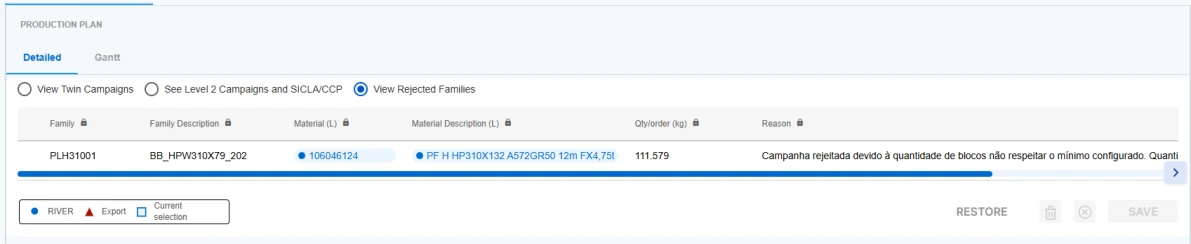
Finally, the output includes a section for rejected campaigns, documenting the specific reasons for rejection and associated profile details.
3. System Capabilities
In both systems, the optimization result screen provides a comprehensive overview of the solution, offering detailed data on simulated scenario execution. It features dedicated tabs for all pre-defined KPIs, along with a detailed report of every campaign and its constituent profiles.
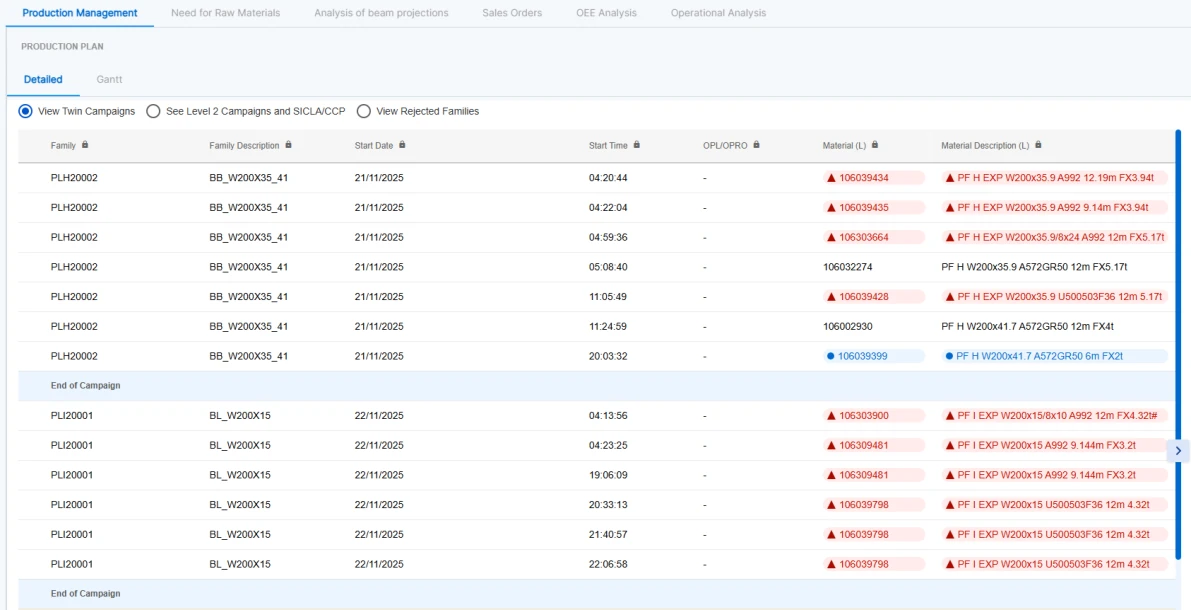
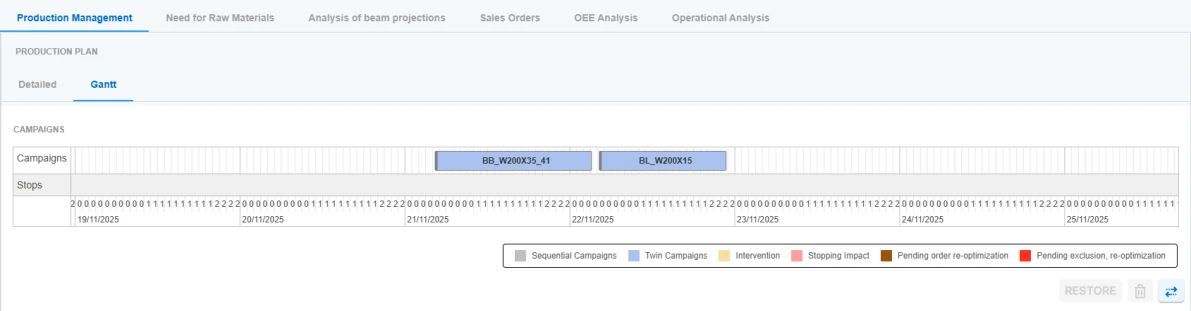
Users can analyze the schedule through a temporal Gantt view and identify campaigns that were excluded from the sequence, including the specific reasons for their rejection.
4. Experimental Results
4.1 Ouro Branco Profile Rolling Mill
The implementation of the digital twin at the Ouro Branco profile rolling mill provided significant improvements in planning accuracy and operational throughput. By analyzing the production data, it is observed that the sequencing engine effectively balances the trade-off between maximizing roll utilization and meeting customer deadlines.
The production analysis charts for the Ouro Branco plant in Figure 6 illustrate the high level of adherence to the digital twin's recommendations. The "Daily Performance" chart shows that the actual production ("Done") closely follows the "Planned" line generated by the digital twin's temporal simulation. While some deviations occur due to unscheduled operational stops, the digital twin proactive stock management allows the mill to adjust quickly and prevent stockout risks from escalating.
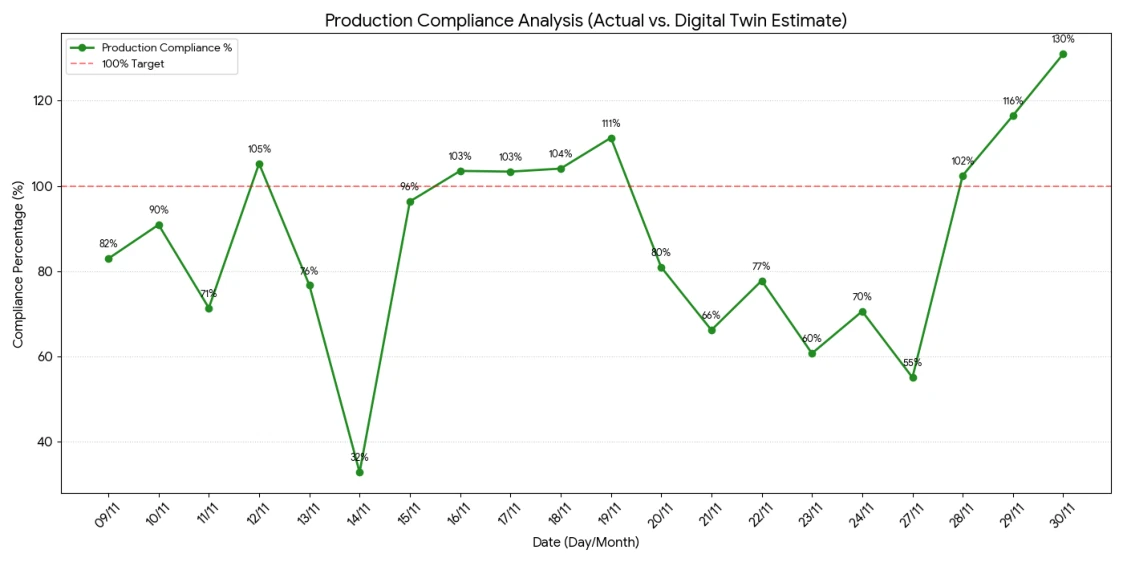
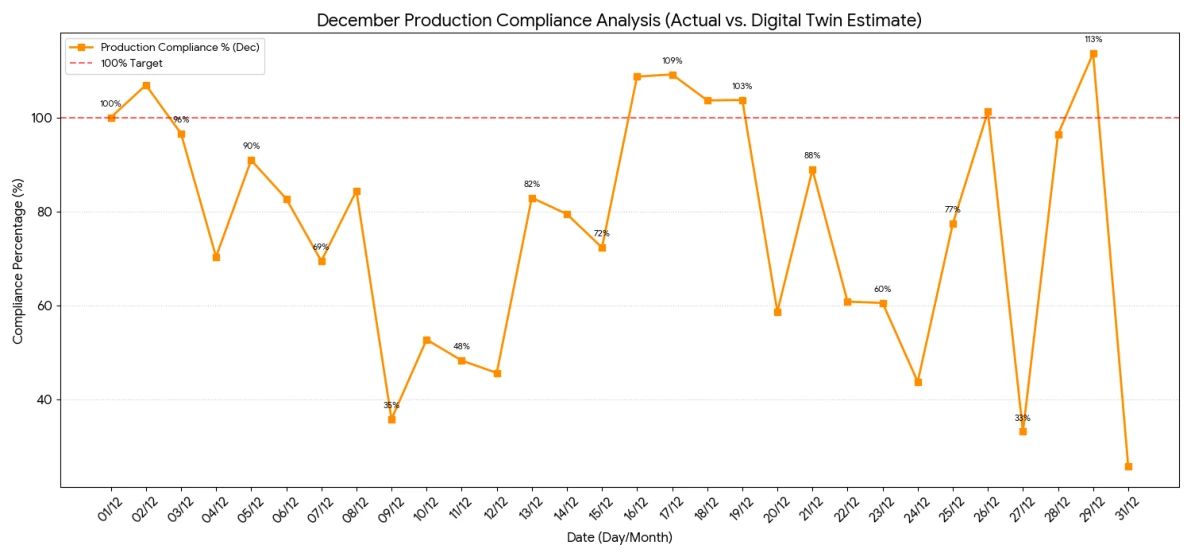
In November, as illustrated in Figure 6, the rolling mill achieved an 87% adherence to the volume planned by the digital twin. In December, this index reached 75.5%; although it represented a slight decrease due to unscheduled downtimes, the operation continued to demonstrate a high degree of compliance with the tool forecasts, as shown in Figure 7.
The consolidated data for November and December proves that the digital twin system is an essential tool for high-volume profile rolling mill sequencing. Even with occasional deviations, the "Daily Performance" chart shows that the actual production ("Done") follows the trend of the planning line ("Planned"). This indicates that the steel mill is executing the sequence of order blocks as optimized by the system, respecting family and roll compatibility.
4.2 Cosigua L3 Profile Rolling Mill
At the Cosigua L3 rolling mill, the implementation of the digital twin has yielded significant operational improvements over the last four months. By transitioning from a fixed, pre-established campaign sequence to a dynamic sequencing engine, the facility has achieved a substantial reduction in cage changes between profile campaigns.
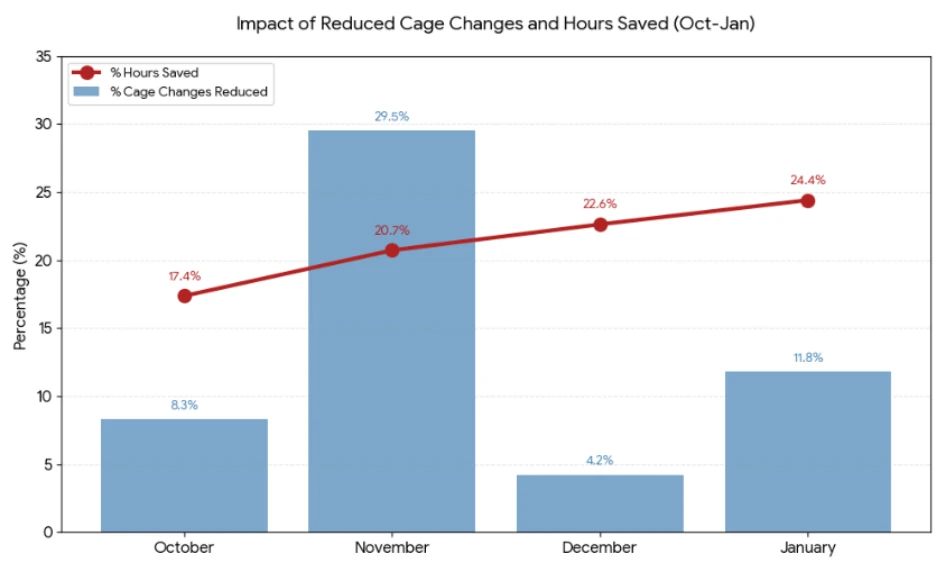
As illustrated in Figure 8, the operational impacts on the Cosigua rolling mill are primarily driven by gains in time efficiency. As previously discussed, the optimizer prioritizes maximizing roll utilization by avoiding unnecessary family and campaign changes while simultaneously monitoring inventory levels. As shown by the blue bars, the tool achieved an average reduction of 13.5% in cage exchanges over the last four months, with a notable peak of 29.5% in November. This intelligent planning has directly translated into a drastic decrease in setup frequency, resulting in a massive amount of saved production hours that were previously lost to manual sequencing constraints. This is reflected in the red lines of the chart. On average, the framework saved 21.3% of the total monthly production time, reaching a high of 24.4% in January, effectively reclaiming hours that were previously lost to manual sequencing constraints. This integration ensures that the increase in available rolling time directly supports customer service goals and proactive inventory management.
Conclusions
The digital twin systems and its integrated sequencing algorithm provide a powerful decision-support tool for profile rolling mill planners. By balancing inventory risk with roll productivity, the system enables the construction of production campaigns that are not only operationally feasible but also strategically aligned with market needs. The algorithm's ability to cluster compatible profiles while respecting complex logistical and physical constraints—such as family transitions and feedstock availability—ensures a high level of operational stability.
In the last two months, the Ouro Branco profile mill achieved an overall adherence of 80.5% to the digital twin’s optimized plan. This high level of compliance demonstrates that the system has successfully become the primary operational driver for the site, ensuring production remains aligned with strategic sequencing. Complementing these results, the Cosigua L3 line specifically demonstrated the algorithm's capacity to optimize setups. By clustering compatible profiles, the line achieved an average reduction of 13.5% in cage changes per month over the period from October to January, saving an average of 21.3% of total production time. Together, these results validate the ability of both frameworks to maintain operational stability and efficiency across different industrial units.
References
- J. Schulz, “Applying Mathematical Optimization in Practice,” Operations Research Forum, Vol. 2, No. 1, 2021, pp. 1-12.
- Z. J. Xu, Z. Zheng and X. Q. Gau, “Operation optimization of the steel manufacturing process: A brief review,” International Journal of Minerals, Metallurgy and Materials, Vol. 28, No. 8, 2021, pp. 1274-1287.
- M. Javaid, A. Haleem and R. Suman, “Digital Twin applications toward Industry 4.0: A Review,” Cognitive Robotics, Vol. 3, 2023, pp. 71-92
- Y. Zhang, M. Sukhram, I. Cameron and A. Rozo, “Industrial Perspective of Digital Twin Development and Applications for Iron and Steel Processes,” AISTech 2020 Conference Proceedings, March 2021, pp. 34-43.
Quer conversar sobre o que leu?
Conte o desafio da sua operação e nossa equipe avalia com você por onde começar.