
AISTech 2026, Pittsburgh, Pensilvânia (EUA)
Tradeoff Management Between Steel Grade Transition and Productivity in Meltshops
Gêmeo Digital com otimização multiobjetivo que reduz as perdas por mistura de aços (mixsteel) na aciaria, mantendo sequências de lingotamento longas e alta utilização dos equipamentos.
Aplicação prática na indústria (Transições de grau de aço e produtividade da aciaria)
Lingotar aços diferentes em sequência no mesmo distribuidor cria uma zona de mistura que vira sucata ou material rebaixado. Com uma carteira diversa e prazos apertados, eliminar as transições não é viável; o artigo mostra como escolher quais aceitar.
Do conceito matemático ao ganho de negócio
- Otimização multiobjetivo
- Pesar no mesmo plano a perda por mistura de aços (mixsteel) e a produtividade, medida por sequências de lingotamento mais longas e maior uso dos equipamentos.
- Matriz de compatibilidade de graus
- Regra explícita de quais trocas de aço são livres, quais geram perda e quais são proibidas, aplicada a cada sequência.
- Gêmeo Digital com simulação temporal
- Antes de executar, o plano é simulado no tempo para prever os KPIs e emitir alertas de produção.
Resultado: Validado em um cenário real de Mini-Mill: qualidade metalúrgica em nível aceitável sem abrir mão da produtividade da aciaria.
Ver o case: Planejamento integrado em Mini-MillAplicações em Siderurgia
Resumo executivo da Enacom, em português, a partir do artigo e dos projetos relacionados.
Resumo
As transições de grau de aço durante o lingotamento contínuo criam compromissos inerentes entre a qualidade metalúrgica e a produtividade da aciaria. Quando graus diferentes são lingotados em sequência no mesmo distribuidor, forma-se uma zona intermediária de mistura, que gera sucata ou produto desclassificado e precisa ser gerenciada com cuidado. No entanto, eliminar totalmente essas transições é inviável, por causa da complexidade da carteira de pedidos e dos prazos de entrega apertados. Este artigo trata do problema de programar uma aciaria para minimizar, ao mesmo tempo, as perdas associadas ao mixsteel e maximizar a produtividade, representada por sequências de lingotamento mais longas e maior utilização dos equipamentos. É proposto um framework de Gêmeo Digital acoplado a uma otimização multiobjetivo, que recebe como entrada um conjunto de demandas e uma matriz de compatibilidade de graus, que define as transições livres, com perda e proibidas entre pares de aços. A solução emprega algoritmos heurísticos para agrupar corridas em sequências, selecionar grupos prioritários considerando as restrições operacionais e simular temporalmente as operações de lingotamento, para prever KPIs detalhados e alertas de produção. A validação em um cenário real de Mini-Mill demonstra que a abordagem alcança níveis aceitáveis de qualidade sem comprometer a produtividade, equilibrando o conflito inerente entre os efeitos da mistura de graus e a eficiência operacional.
Resumo traduzido do original, publicado em inglês.
Palavras-chave
OptimizationSteel GradeProductivityMeltshopsDigital Twin
Artigo completo
Texto completo do artigo, em inglês.
Introduction
The use of optimization algorithms to improve the performance of steel plants has been extensively studied in the literature, covering everything from aggregate planning to detailed scheduling of steelmaking and continuous casting operations1,2. The implementation of these algorithms in industrial software systems has led to significant gains in efficiency, better asset utilization, and increased profitability in real steel plants3. In the specific context of steelmaking and continuous casting (SCC), the scheduling problem is often modeled as a variant of the Hybrid Flow Shop (HFS) problem, with multiple stages, parallel resources, and many technological and operational constraints2,4.
In parallel, digital twin technology has gained prominence as a tool for industrial optimization, as it enables the construction of detailed virtual models of production lines capable of simulating, in time, the evolution of process variables and discrete events under different operating scenarios5,6. In the steel industry, digital twins have been successfully applied in several parts of the chain, including steelmaking, continuous casting, and rolling, providing performance indicators, identifying bottlenecks, and supporting planning and operational decisions in near real time5,6.
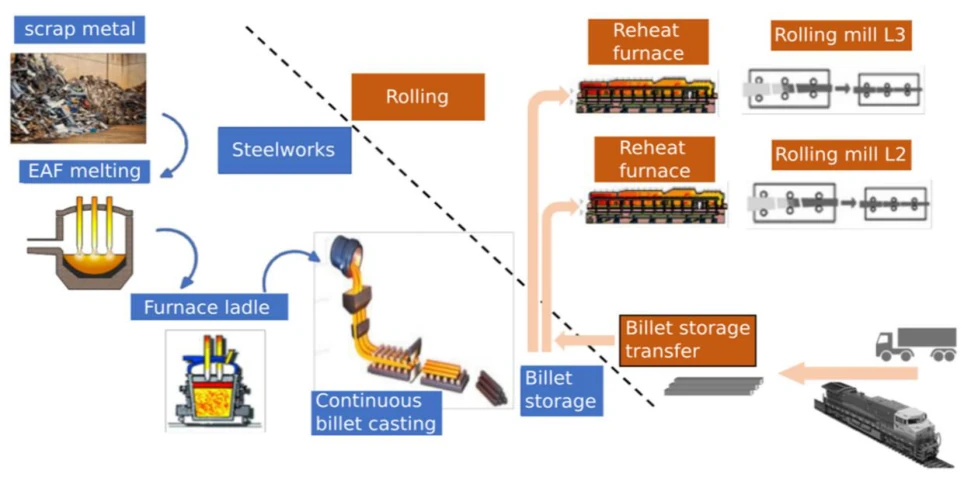
The COSIGUA meltshop, which is the focus of this work, is configured as a Mini-Mill, that is, a compact and integrated plant that covers the route from scrap melting to hot rolling of long products7,8. The typical route starts with scrap melting in an electric arc furnace (EAF), followed by a relatively simple refining stage and continuous casting of billets in two cross-sections, 130 mm and 160 mm8. In the subsequent stage, the billets are sent to two different rolling mills: the L2 mill, which processes only 130 mm billets and has hot furnace capability, and the L3 mill, which can roll both billet sizes but without hot charging8. In this configuration, the way casting sequences are planned in the meltshop directly affects both on-time delivery performance and the percentage of billets that reach L2 at suitable temperature for hot furnace operation8.
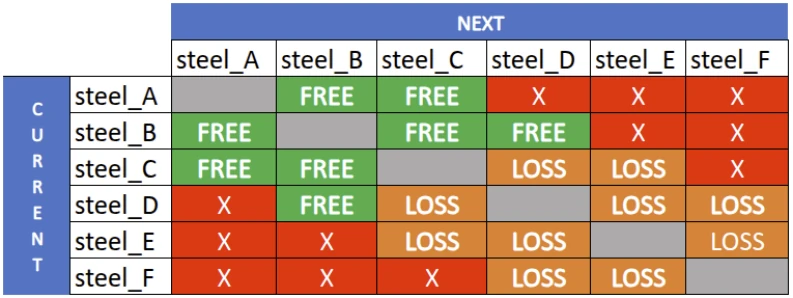
Continuous casting at COSIGUA is organized into long sequences of heats poured into the same tundish, while several operational constraints are respected, such as minimum and maximum numbers of heats per sequence, tundish capacity, gauge campaigns, yard storage capacity, and maintenance windows8. Among these constraints, the compatibility rules between steel grades, described by a mixsteel matrix that classifies each pair of grades as free transition, transition with loss, or forbidden transition, play a central role8. This matrix determines which grades can be cast in sequence in the same tundish, which generate a strand segment that must be scrapped or downgraded, and which require a sequence break, thereby creating a direct trade-off between metallurgical quality, mixsteel losses, and meltshop productivity8.
In this context, the problem addressed in this paper is to schedule COSIGUA’s meltshop operations in such a way as to meet a monthly order book with multiple steel grades and different delivery deadlines, while simultaneously maximizing productivity (long sequences, high hot furnace utilization, high resource usage) and minimizing the negative effects of grade transitions (mixsteel). To accomplish this, a digital twin of the meltshop is coupled with a multiobjective optimization scheme that takes as input a set of demands discretized into casts and a grade-compatibility matrix, building and simulating scheduling scenarios that make explicit the trade-off between steel grade transition and productivity in meltshops similar to COSIGUA’s3,5,8.
Discussion
1. Steel Grade Transition
In continuous casting, steel grade transition occurs when two heats with different chemical compositions are cast sequentially through the same tundish without interrupting the metal flow. During this change, the new grade progressively displaces the previous one inside the tundish and mould, forming an intermediate mixing zone whose composition and properties do not fully match the specifications of either of the original grades, a phenomenon commonly referred to in the literature as grade intermixing9.
From a physical standpoint, this mixing region is governed by the transient flow in the tundish, axial dispersion, possible dead zones and recirculation areas, as well as by the hydraulic residence time of the liquid steel. Operating variables such as tundish steel level and casting speed directly influence the volumetric extent of this intermediate zone: lower levels and higher renewal rates tend to reduce the volume of intermixed steel, whereas conditions that favour recirculation enlarge the intermixing region.
In industrial practice, the transition between two grades is classified into three categories according to the metallurgical impact of the mixing:
1.1 Free Transition
This corresponds to pairs of grades whose chemical compositions and specification windows are sufficiently close so that the entire mixing zone remains within the acceptable limits of at least one of the grades involved. In these cases, the strand segment corresponding to the transition can be fully assigned to either the previous grade or the new grade, without any need for scrap generation or downgrading. In terms of grade intermixing, the concentration curve during the changeover remains entirely inside the specified product envelope.
1.2 Transition with Loss
In this situation, mixing between the two grades produces an intermediate composition range that does not satisfactorily comply with the specifications of either grade. The strand segment associated with the transition must be segregated, either as internal scrap returned to the process or as downgraded product assigned to less demanding applications. Studies of tundish mixing quantify this interval based on the temporal evolution of concentration at the tundish outlet and allow the definition of cut limits upstream and downstream of the transition, thereby determining the volume of steel that must be treated as a quality loss for each grade pair.
1.3 Forbidden Transition
There are grade pairs for which any degree of mixing is unacceptable, for example when there are large differences in carbon content, very different cleanliness requirements, the presence or absence of critical microalloying elements (Nb, Ti, B), or extremely tight limits on mechanical properties and corrosion resistance. In such cases, even small amounts of intermixing may lead to internal defects, undesired precipitations, or complete loss of compliance with product standards, so that direct transition in the same tundish is not allowed. These pairs are treated as incompatible and require more stringent grade change strategies, such as controlled tundish changes, extreme tundish level reduction, or even temporary interruption of casting to avoid any overlap of compositions.
In practice, the free, with‑loss, and forbidden transitions between steel grades are encoded in a grade‑compatibility matrix that is provided as an input parameter to the digital‑twin scheduling systems implemented in the COSIGUA Mini-Mill and in the GERDAU integrated meltshop at Ouro Branco. In the COSIGUA case, this matrix is used during batch construction to restrict which steel labels can follow each other within a continuous‑casting sequence, directly influencing the formation of homogeneous campaigns and the occurrence of mixsteel events8. In the Ouro Branco steelworks, an analogous set of mix‑steel rules is applied in the constructor module to group charges into sequences and in the scheduler to respect metallurgical compatibility when allocating these sequences in time and across different casting machines10. For every ordered pair of grades, the matrix specifies whether the transition is free, allowed with a defined quality loss (and associated scrap or downgrade rate), or forbidden, and thus constitutes a central metallurgical constraint in both the construction of casting sequences and the global production scheduling. An example of such a grade‑compatibility matrix used in industrial practice is shown in Figure 1.
2. Productivity in Meltshops
Productivity in a continuous casting meltshop is determined not only by the instantaneous casting rate (t/h), but also by the fraction of time the machine is effectively producing specification-compliant steel; that is, "good tons" per unit of time. Studies on continuous casting machine productivity highlight that increasing output fundamentally involves two fronts: raising the casting rate (casting speed and section) and maximizing liquid casting time by reducing stops, changes, and machine setups.
In industrial practice, when planning to meet a monthly order book with multiple customers, different steel types, and often tight delivery deadlines, transitions between grades within the same casting sequence become inevitable. Reviews of scheduling in steelmaking and continuous casting emphasize that the combination of grade variety, smaller lots, and just-in-time requirements increases the number of grade changes and CCM setups, making the scheduling problem more complex with direct impact on productivity and cost.
From a metallurgical standpoint, each grade transition generates a mixing zone (intermixing) in the tundish and strand, whose behavior was detailed in classic intermixing models. As discussed in the previous section, this zone can be classified for each grade pair as free transition, transition with loss, or forbidden transition. In a complex order book scenario, the combination of order portfolio composition and delivery deadlines forces the meltshop to accept a certain number of transitions with loss (material scrapped or downgraded) and, in some cases, to interrupt sequences to respect forbidden transitions.
From a productivity perspective, a scenario with many transitions throughout the month tends to produce shorter casting sequences. Each new sequence implies, to a greater or lesser degree, additional operations: tundish changes or preparations, speed adjustments, level and temperature stabilization, plus the metallurgical stabilization time during grade change. Studies on tundish transition phenomena emphasize that the most aggressive mixing reduction strategies—such as flying tundish change or grade separators—shorten the intermixing zone but at the cost of greater downtime and operational complexity [8].
Thus, from a meltshop productivity standpoint, the ideal scenario is one where long casting sequences can be assembled with minimum number of transitions and, within these, predominance of free transitions where the transition steel can be assigned to one of the grades without penalty. Long sequences reduce the frequency of machine stops and setups, increasing liquid casting time, while reducing transitions with loss and eliminating forbidden transitions increases metal yield and the fraction of good tons over total produced.
In contrast, highly fragmented order books, with a high number of distinct grades and strong dispersion of delivery deadlines, tend to generate precisely the opposite: more short sequences, more mixing zones, and greater volume of scrapped or downgraded steel, compromising both meltshop productivity and the effective quality of the produced portfolio.
3. Multiobjective Optimization
In continuous casting meltshop operations, mixsteel events directly impact both productivity and steel quality. Scenarios with many grade transitions result in shorter casting sequences, more tundish changes, and higher scrap/downgrade rates, simultaneously compromising machine utilization and metal yield. However, achieving a completely mixsteel-free schedule is practically impossible due to order book diversity and tight delivery deadlines that force grade mixing to meet customer demands.
Multiobjective optimization addresses this inherent conflict by simultaneously minimizing mixsteel-related losses (quality penalty) while maximizing casting sequence length and machine uptime (productivity). The optimization problem thus balances the metallurgical cost of grade transitions—quantified through the grade-compatibility matrix—with operational constraints on sequence length, tundish capacity, and due date compliance. Practical solutions seek Pareto-optimal schedules that ensure acceptable quality levels without excessively sacrificing productivity, recognizing that some controlled mixsteel is inevitable for feasible production planning.
The multiobjective nature of the problem reflects the reality of modern meltshops, where maximizing good tons per hour and minimizing quality losses are intrinsically antagonistic. Digital-twin models, as implemented at COSIGUA and Ouro Branco, explicitly incorporate these competing objective functions, using heuristics and mixed-integer linear programming to explore solutions and present the user with alternatives that balance minimum mixsteel with long sequences and due date compliance. This approach allows the meltshop planner to select the solution that best matches the month's specific priorities, whether prioritizing maximum quality or maximum production.
4. Solution Architecture
The proposed solution begins with a preprocessing stage, which is shown in Figure 2, that receives, as input, a JSON file containing the set of demands for the scenario to be simulated and the list of valid mixsteel relations between various steel grades. This JSON includes, for each demand, information such as billet type, steel grade, required tonnage, delivery date, and any additional constraints, along with the grade compatibility table where each steel pair is classified as free transition, with loss, or forbidden. In preprocessing, demands are first grouped by billet type to respect geometric and process route constraints; from each group, the system generates a list of "heat" objects that collectively meet the required tonnage and distribute casting dates coherently with order book deadlines. In parallel, the mixsteel list is converted into an internal matrix object where each ordered pair of grades is associated with the allowed transition type and, when applicable, a loss factor quantifying the volume of intermixed steel to be scrapped or downgraded. This mixsteel matrix becomes the central structure used in subsequent simulation stages to evaluate, during casting sequence formation, which transitions can occur without penalty, which are accepted with controlled loss, and which are strictly forbidden, requiring sequence breaks or tundish changes.
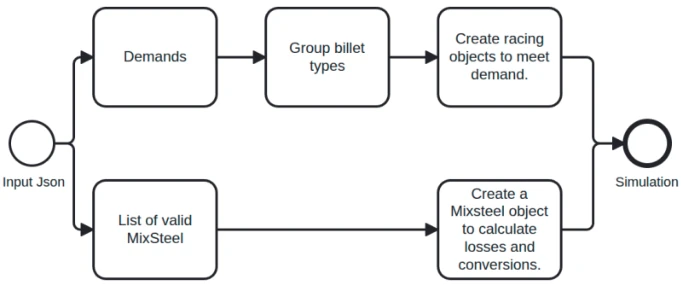
With the heat list and mixsteel matrix object properly prepared in preprocessing, the core simulation begins following a main iterative cycle, as shown in Figure 3.

The process is organized into a main loop comprising four interdependent stages that repeat until complete exhaustion of available casts:
- Grouping casts into candidate groups for sequences - detailed in Figure 4 - Cast grouping process.
- Selecting the priority group to form the next sequence - detailed in Figure 5 - Group selection for sequences.
- Actual sequence construction from the selected group.
- Detailed temporal simulation of the sequence on meltshop equipment.

Cast grouping into candidate groups follows a greedy heuristic that systematically prioritizes order book urgency. The process begins by identifying the steel grade with the most critical demand, determined by the shortest remaining delivery deadline among all pending demands. Among all available casts of this steel type, the first viable cast that has not yet been allocated is selected. Using this cast as the group's starting point, all remaining casts whose steel grade is compatible with the steel of the group's last cast are then filtered, according to the mixsteel matrix, only transitions classified as "free" or "with allowed loss" are considered.
The group is then iteratively expanded: at each iteration, the most urgent compatible cast among those available is selected, where "urgency" is calculated by a composite function that weighs: (i) proximity of the due date to the current simulation date, (ii) preference for maintaining the same steel type as the group's last cast (mixsteel minimization). This expansion process continues until one of the following stopping conditions is met: (a) no more compatible casts are available, (b) maximum group capacity restrictions are reached (heat limit or tonnage per sequence), or (c) all casts of the priority steel type have been allocated.

Next group selection for sequence formation incorporates multiple operational constraints and competing objectives, reflecting real meltshop scheduling complexities. The process begins by checking section change feasibility on the casting machine: groups requiring gauge change (from 130mm to 160mm or vice-versa, in the COSIGUA case) receive a significant priority penalty, considering time lost in mechanical adjustments and caster setup.
Groups already showing violations of critical operational constraints — such as storage yard capacity overrun, daily cast limit violation, etc. — are penalized with the lowest possible selection priority.
From these initial penalties, all candidate groups are ranked through a hierarchical scoring function that considers, in decreasing order of importance:
- Accumulated delay: sum of projected delays for demands contained in the group.
- General urgency: weighted average urgency of individual heats.
- Section compatibility: penalty if gauge change required relative to last sequence.
- Average due date: prioritizing groups with nearer deliveries.
The group with the highest final score is selected to form the next casting sequence.
With the group defined, sequence construction proceeds, where casts are internally ordered strictly respecting the mixsteel matrix and optimizing consecutive grade transitions — preferring free transitions whenever possible and minimizing total transitions with loss.
Temporal simulation then allocates each sequence operation to meltshop equipment — converters, secondary refining (when applicable), casting — considering steel grade-specific processing times, setup times between sequences (tundish change, speed adjustments), equipment capacity constraints, available time windows, and scheduled or seasonal restrictions.
At the end of each sequence simulation, the system checks if unallocated casts remain. If yes, the complete cycle restarts with grouping of remaining heats. If no, simulation ends, consolidating all results into final reports with detailed KPIs (hot furnace rate, delays, equipment utilization), production alerts, and complete temporal execution details of the entire scenario.
5. Results
To validate the results of the proposed model, a scenario was constructed in which the melt shop must supply three rolling mills, while simultaneously seeking to avoid delivery delays and to minimize losses resulting from the mixing of different steel grades. Figure 06 shows the distribution of the required delivery dates for each rolling mill throughout the planning horizon.
It can be observed that the second rolling mill presents a higher demand volume than the others, which highlights the balancing performed by the digital twin in production planning. This behavior indicates that the model is capable of allocating production in a manner consistent with the system’s constraints and priorities, respecting the differences in workload among the rolling mills.
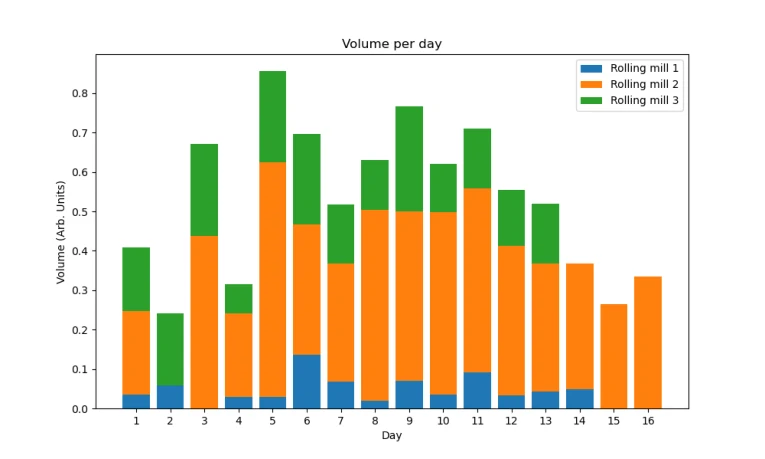
It is also noted that, in the final days of the analyzed horizon, there is a reduction in total demand. As a consequence, the melt shop is able to anticipate production, requiring only 11 days to complete the entire planned volume. This scenario reproduces a common behavior in real planning problems, in which demand tends to decrease toward the end of the horizon due to uncertainties associated with production forecasts and future orders.
In this scenario, 19 steel grade changes with losses were recorded. Figure 07 presents the daily distribution of the number of occurrences of steel mix transitions with losses, allowing an assessment of how these changes evolve over time.
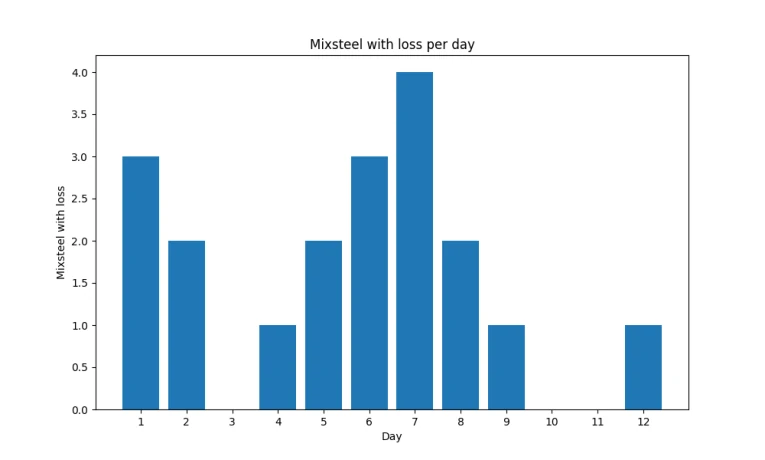
With respect to productivity, a relatively stable behavior is observed throughout the days, as illustrated in Figure 08. Even with the reduction in steel grade changes with losses, there are no significant variations in the daily production rate.
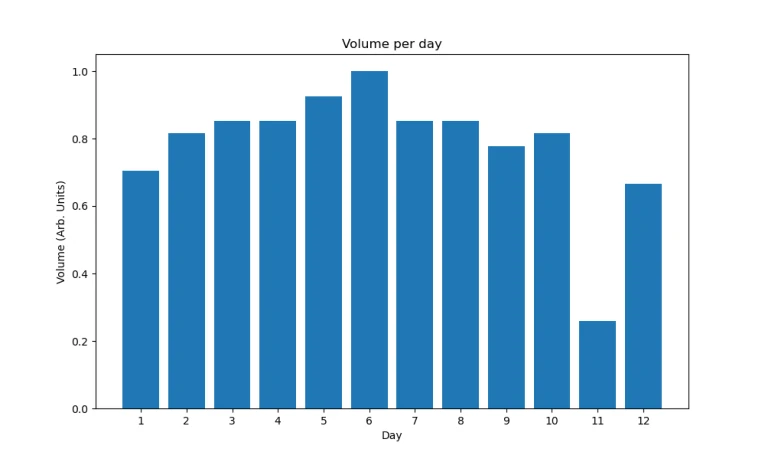
These results indicate that it was possible to reduce the number of steel mix transitions with losses without significantly compromising productivity, highlighting the effectiveness of the adopted multi-objective optimization approach. In this way, the model demonstrates its ability to balance conflicting objectives, contributing to more efficient planning aligned with the operational constraints of the steel plant.
Conclusions
This work has presented a comprehensive framework for managing the trade-off between steel grade transition and productivity in meltshop operations. The analysis demonstrates that steel grade transitions inevitably generate intermixing zones in continuous casting, and while three categories of transitions—free, with loss, and forbidden—can be systematically managed through a grade-compatibility matrix, completely avoiding mixsteel is impractical in real production scenarios with diverse order books and tight delivery constraints.
The proposed digital twin solution successfully integrates multiobjective optimization into the scheduling process, simultaneously addressing metallurgical, operational, and economic objectives. By decomposing the problem into cast grouping (based on urgency and grade compatibility), group selection (considering gauge changes, delays, and capacity violations), and temporal simulation (accounting for equipment constraints and setup times), the framework provides meltshop planners with Pareto-optimal solutions that balance competing goals.
Validation results from the Mini-Mill indicate that the approach can effectively reduce steel grade transitions with losses (19 documented in the test scenario) while maintaining stable productivity levels throughout the planning horizon. This demonstrates that thoughtful sequence construction and prioritization can minimize quality losses without sacrificing machine utilization, a critical finding for industrial competitiveness.
References
- Z. J. Xu, X. Q. Gao, “Operation optimization of the steel manufacturing process: A brief review,” International Journal of Minerals, Metallurgy and Materials, Vol. 28, 2021, pp. 1274–1287.
- (G. Dutta, R. Fourer, “A Survey of Mathematical Programming Applications in Integrated Steel Plants,” Manufacturing & Service Operations Management, Vol. 3, No. 4, 2001, pp. 387–400.
- P. H. F. Campos, T. B. F. Tamantini, I. F. S. Amaral, M. O. Mendonça, G. R. L. Silva, G. J. Duarte et al., “Production Scheduling Optimization for the Steelmaking,” Proceedings of the 24th ABM Automation and IT Seminar, Vol. 24, No. 24, 2022, pp. 203–216.
- R. Ruiz, J. A. V. Vázquez-Rodríguez, “The hybrid flow shop scheduling problem,” European Journal of Operational Research, Vol. 205, No. 1, 2010, pp. 1–18.
- Y. Zhang, M. Sukhram, I. Cameron, A. Rozo, “Industrial Perspective of Digital Twin Development and Applications for Iron and Steel Processes,” AISTech 2020 Conference Proceedings, 2021, pp. 34–43.
- M. Javaid, A. Haleem, R. Suman, “Digital Twin applications toward Industry 4.0: A Review,” Cognitive Robotics, Vol. 3, 2023, pp. 71–92.
- U.S. Environmental Protection Agency, “12.5.1 Steel Mini-Mills,” AP-42, 5th ed., Vol. I, 1995 (updated), available at: https://www3.epa.gov/ttnchie1/ap42/ch12/final/c12s05-01.pdf
- F. S. Kolberg, P. H. F. Campos, T. H. S. Pinto, R. S. Santos, G. C. Fraga, M. O. Mendonça, G. R. L. Silva, D. A. G. Vieira, B. Alvares, B. S. Breder, “Hot rolling optimization of a Mini-Mill scheduling considering metalworking due dates and mixsteel restrictions,” AISTech 2024 – Proceedings of the Iron & Steel Technology Conference, Vol. 69, 2024, pp. 1148– 1157.
- Thomas, B. G. Modeling study of intermixing in tundish and strand during a continuous-casting grade transition. Iron and Steelmaker (ISS Transactions), v. 24, n. 11, 1997, p. 83‑96.
- P. H. F. Campos, F. S. Kolberg, M. H. L. Faria, M. O. Mendonça, G. J. Duarte, M. C. A. Pires, W. L. Santos, L. F. L. Notini, B. Alvares, B. S. Breder, "Optimizing supply chain scheduling in steel mills: an algorithm leveraging digital twin technology," AISTech 2024 - Proceedings of the Iron & Steel Technology Conference, Vol. 69, 2024, pp. 2108-2115.
Quer conversar sobre o que leu?
Conte o desafio da sua operação e nossa equipe avalia com você por onde começar.