
How Digital Twins work
The process of creating and manipulating a Digital Twin involves several technologies. This innovative solution, which is only set to grow and is proving crucial not only to current market movements but to consolidating the next ones, such as Industry 5.0, depends on other innovative and already well-established technologies to do its job. Among the main ones, we highlight:
Machine Learning
In the Digital Twin, machine learning can be used as a complement to artificial intelligence, for example, enabling the creation of better automation models. In this way, an additional layer of intelligence can be used to display predictions and thus support decision-making so that developers and engineers can make decisions in real time.
Internet of Things
For a Digital Twin to work, it is essential that operational data be collected. Thus, its depth, level of detail and the connection that supports real-time transfer to the cloud are only possible through IoT. With smart devices and sensors, engineers and developers can map the entire behavior of a piece of equipment in the field, for example.
Artificial Intelligence
Artificial intelligence can be part of a Digital Twin's DNA, helping the company's competitiveness. This is because, using detailed data, the twin can leverage its AI functionalities to predict usage conditions, look for anomalies in its operation and, in this way, automatically find the answers to optimize itself.
By combining the best of AI and Machine Learning in a Digital Twin, it is possible to develop software capable of delivering complete prescriptive analytics, as well as creating complete action plans on how to improve the physical equipment being developed based on assertive predictions.
Big Data
Without Big Data, it would simply not be possible to build a Digital Twin that replicates the entire operation of a physical product.
This is because it requires countless data, especially in industrial twins, such as temporal, transitional, analytical and physical data, and data specific to building visual models. This makes this technology essential within a Digital Twin.
What are the types of Digital Twins?
Digital Twins can be developed for different purposes. Depending on the goal, it is possible to create Digital Twins of products, of processes or even of entire systems. That is why we have mapped 3 types of twins to help you understand the difference between them. Check them out:
Product
The product Digital Twin is an exact digital replica of something being designed for the real world. It is developed based on operational and statistical data to understand its performance in different scenarios and under varied conditions.
Performance
The performance Digital Twin seems similar to the product twin; however, its goal is to focus more on process optimization. That is, it is created from production data and uses artificial intelligence, machine learning and deep learning to generate insights that help improve the performance of a physical solution in a given application.
Production
The production Digital Twin, in turn, is broader because it considers the creation of an entire production system, thus providing a way to understand the operational flow and its details in relation to predictive maintenance or the operation's productive and/or idle capacity.
How does a Digital Twin work?
In applications of the twin to a product that already exists but requires improvements for new industry demands, for example, it is necessary to capture all of that product's data through IoT sensors.
The goal is to continuously capture operational, physical, chemical, and environmental data, and anything else that is needed. The collected data is transferred to the cloud while the development team works on statistical scenarios to create the new equipment model.
The statistical data is used to refine the operational data collected in the real application environment, so that, combined, they serve as the basis for creating a statistical and engineering model.
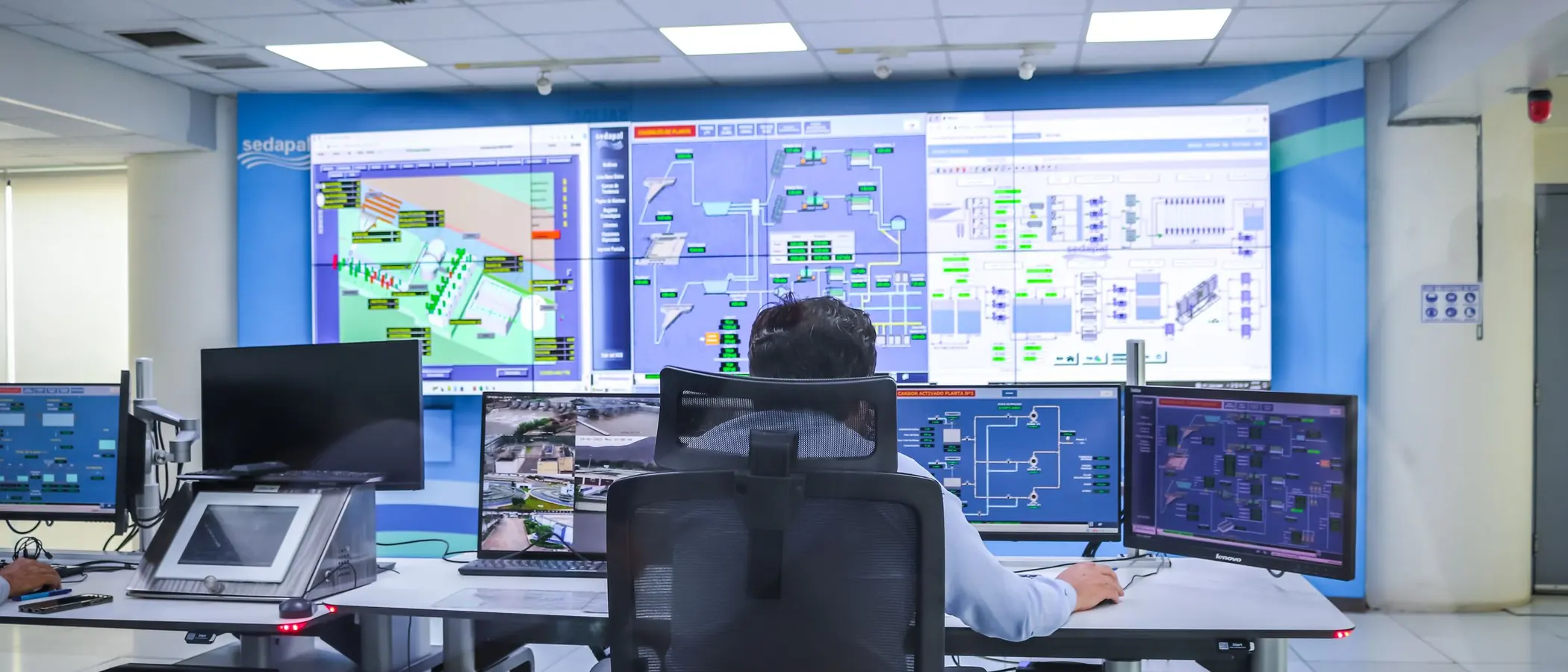
With this body of information, engineers, developers and project managers can create a digital 3D model of the machine, analyzing its performance in real time, but virtually, thus creating a Digital Twin.
The Digital Twin works as an inexhaustible, rich and efficient source of insights that are fed back to the physical asset, in order to improve its development and operation.
At Enacom we are recognized for our solutions using Digital Twins. Would you like to apply this tool in your company? Talk to our team, we can help you!
Learn more: explore the Gemminus platform.