Steel Planning and Scheduling: Mathematical Optimization and Digital Twins from the Blast Furnace to the Rolling Mill
Connect production planning and control (PCP), fine scheduling (APS), and operational execution (S&OE) in a single decision ecosystem. Enacom models the real metallurgical, thermal, and logistics constraints of your mill to unlock production capacity without CAPEX, stabilize the flow, and reduce conversion costs.
Synchronization between stages: where ERP and off-the-shelf APS systems fall short
In an integrated mill or a mini-mill, operating results are lost at the interfaces between processes. A change in the continuous casting queue, a sudden overhead crane outage, or a variation in hot metal chemistry makes the master plan outdated within minutes.
Traditional ERP systems and generic APS software work with simplified rules or infinite capacity that do not reflect the physics of the mill. The result is a return to parallel spreadsheets, excess moves in intermediate yards, lost thermal energy, and steel produced with no order attached (orphan stock).
Enacom’s Planning and Performance Digital Twin (Gemminus Platform) works precisely in this gap: it combines Operations Research (Mixed-Integer Linear Programming, MILP, and multi-objective optimization) with Artificial Intelligence to recalculate complete sequences in seconds or minutes while respecting the plant’s operating constraints. We do not replace the ERP, MES, or APS already in use: we connect to them and add the decision layer missing between the tactical plan and the shop floor.
The figures on this page come from cases and technical papers presented at events such as AISTech and ABM Week. The conditions under which each result was obtained are described in the cases themselves.
15 → 6moves at most to build a load in the yard
12.2%of the volume hot charged, without moving ahead of delivery dates
48 hof lead time in torpedo car scheduling
+1%monthly production in the steel shop, with no infrastructure investment
Why it works: the solution sees the whole mill before deciding
Each area of a mill optimizes its own side, and results are lost in the handoff between stages. The solution decides with a view of the whole, using rules the mill itself approves, and the gain comes from capacity that already exists.
Steel shop and rolling stop competing
Producing more in the steel shop can overload the yard and delay rolling. The solution compares the possible plans considering both stages and picks the one that pays off most overall. Measured result: 17% less steel with no customer order in heat formation.
More output without construction or new equipment
The gain comes from time and capacity that already existed and was lost between stages. In a paper presented at AISTech 2024, the steel shop’s monthly output rose about 1%, with no infrastructure investment. The investment is the project, and the return is measured as additional volume times the product margin.
Less waste and less risk
In the yard, the maximum number of moves to build a load fell from 15 to 6, with less idle time and less safety risk. When something changes, the plan is rebuilt in under a second.
Decision validated before scaling
The specialist validates the plan on known periods of the mill and in a pilot, and only then does the scope grow. The decision risk stays small and the return is verified early.
Financial return. The value in reais depends on each operation’s volume and margin. We calculate the return and payback period with your company’s data, before scaling the project.
Where we work: optimized decisions at every link of the mill
Each front below brings together the decision the operation has to make, the technology applied, and the proof: the result measured in a case and the technical paper behind the method.
Steel Shop, Heat Formation, and Continuous Casting (APS / S&OE)
We synchronize the scheduling of converters (BOF) and electric arc furnaces (EAF), secondary metallurgy, and continuous casting machines. The algorithm balances sequence productivity (tundish life), steel grade transition windows, and on-time delivery of commercial orders.
Heat Formation and Co-scheduling of Converters and Ladle Furnace (Heat Scheduling)
Heat formation is treated as a knapsack problem combined with co-scheduling of the refining resources. Over 12 months of real data, co-scheduling cut the average idle volume from 12.61% to 10.47%. In the heat-former case, the steel shop produced 17% less steel with no customer order.
Continuous Casting Sequencing and Heat Plan (SCC Scheduling / HFSP)
The steel shop and caster are modeled as a hybrid flow shop (HFSP), with a constructor, sorter, and scheduler architecture. The approach scales to more than 1,500 heats in about an hour and raised monthly production by about 1%, with no infrastructure investment, in a paper presented at AISTech 2024.
Grade Transition and Mixsteel Losses (Grade Transition Management)
A Free, Loss, and Forbidden compatibility matrix between steel grades enters as both a constraint and an objective of the optimization, balancing transition losses and productivity. The production manager compares alternatives instead of accepting a single sequence.
Real-Time Replanning (S&OE)
When shop-floor status changes, the plan is rebuilt from the current state. The steel shop moves from a shift plan to one that tracks what is actually happening.
Measured impact: 17% less steel with no customer order in steel shop heat formation.
Internal Hot Metal Logistics and Torpedo Car Allocation (Hot Metal Logistics and HMR)
Liquid hot metal can neither wait nor be stored: if the torpedo car is late, the steel shop stops, and if there is excess hot metal, it is tipped. We dynamically manage the hot metal transport cycle between blast furnaces and the steel shop: the prescriptive model anticipates the balance between production and consumption, cuts liquid metal waiting time, and aligns fleet turnover with maintenance stops.
Torpedo Car Fleet and Maintenance Scheduling (Torpedo Car Scheduling)
All cars are planned 48 hours ahead and replanned in under a second when real status changes. Scheduling accounts for the maintenance cycle, service-life limit, and maximum waiting time, which lowers the risk of emergency tipping and the fleet required.
Hot Metal Rate (HMR) and Early Tipping Alerts
A lexicographic heuristic first minimizes hot metal spills and then the sum of HMR levels across converters. The system alerts 48 hours ahead of an excess or shortage and suggests adjustments per furnace. In a 30-day test, tipped cars fell from 61 to 29.
Integrated View of Scheduled Downtime
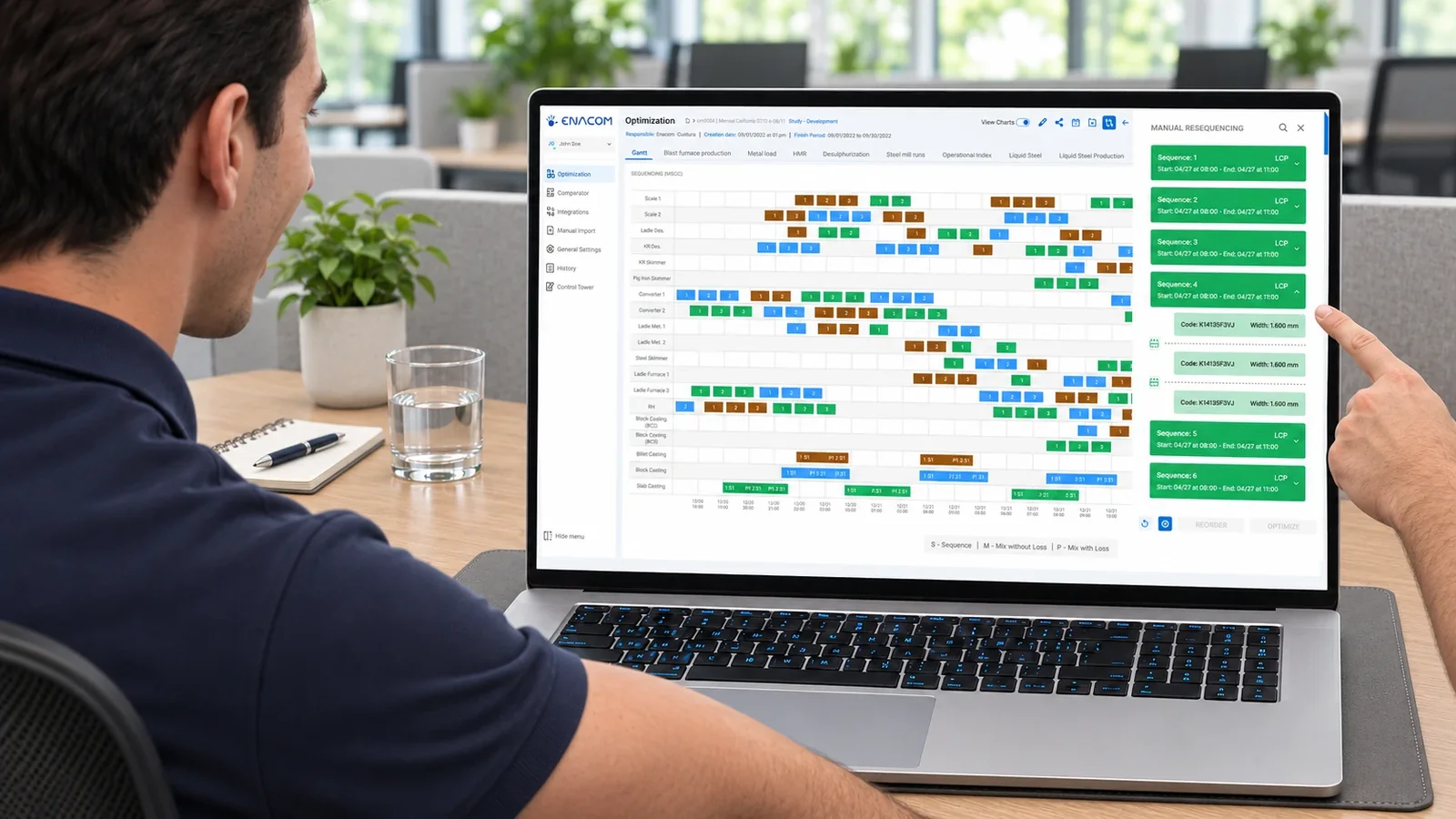
Blast furnace, scales, ladle stations, and casters sit in a single Gantt view, to coordinate maintenance windows without unplanned loss of productivity.
Measured impact: Torpedo car fleet planned 48 hours ahead and replanned in under 1 second when contingencies arise.
Slab and Billet Yards and Overhead Crane Sequencing (Yard Management and Crane Scheduling)
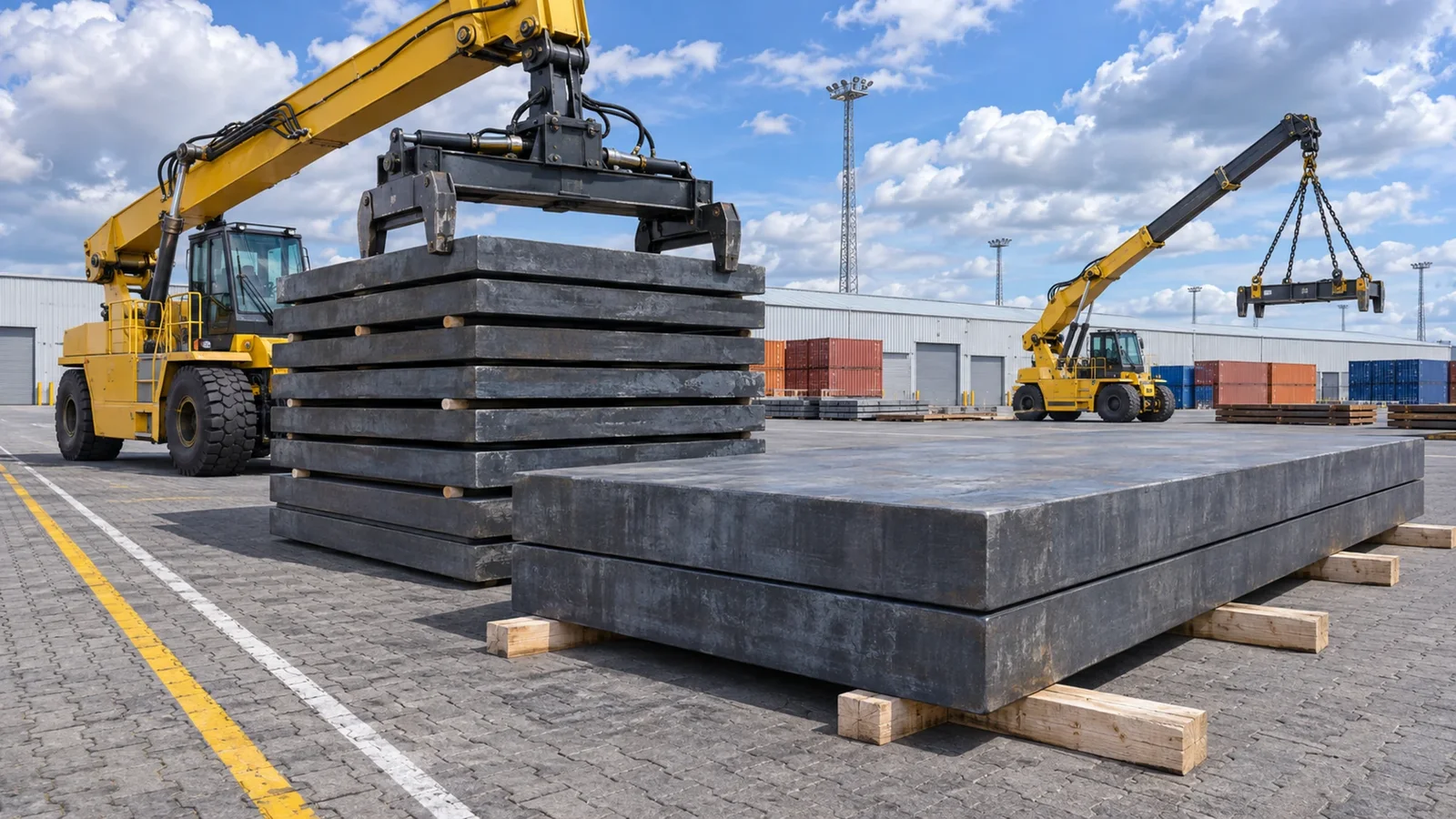
Every extra crane move consumes time, raises safety risk, and disorganizes the yard. The Digital Twin eliminates rehandling (unproductive pile moves) in intermediate yards: it sets the optimal unloading location and the exact overhead crane move sequence to build each load, respecting cooling curves and shipping priorities.
Overhead Crane Scheduling and Load Building (Crane Scheduling)
A heuristic defines the next moves of cranes and roller tables, considering physical limits, stacking rules, and equipment availability. In the real case, the maximum number of moves to build a load fell from 15 to 6, and the solution beat the operators’ manual planning. The work was published in Iron & Steel Technology, from AIST.
Early Stock Reorganization and Stacking Rules (Stock Relocation)
The system reorganizes stock to minimize future moves and distributes slabs across yards according to cutting, finishing, and controlled-cooling needs. Safety-rule violations from incorrect stacking were eliminated.
Road and Rail Dispatch Planning at D+3 (Dispatch Planning)
Loads are planned three days ahead, which makes shipping capacity more predictable and reduces vehicle waiting cost.
Measured impact: From 15 down to at most 6 overhead crane moves to build a load in the yard.
Hot Charging and Energy Efficiency in Reheating (Furnace Scheduling)
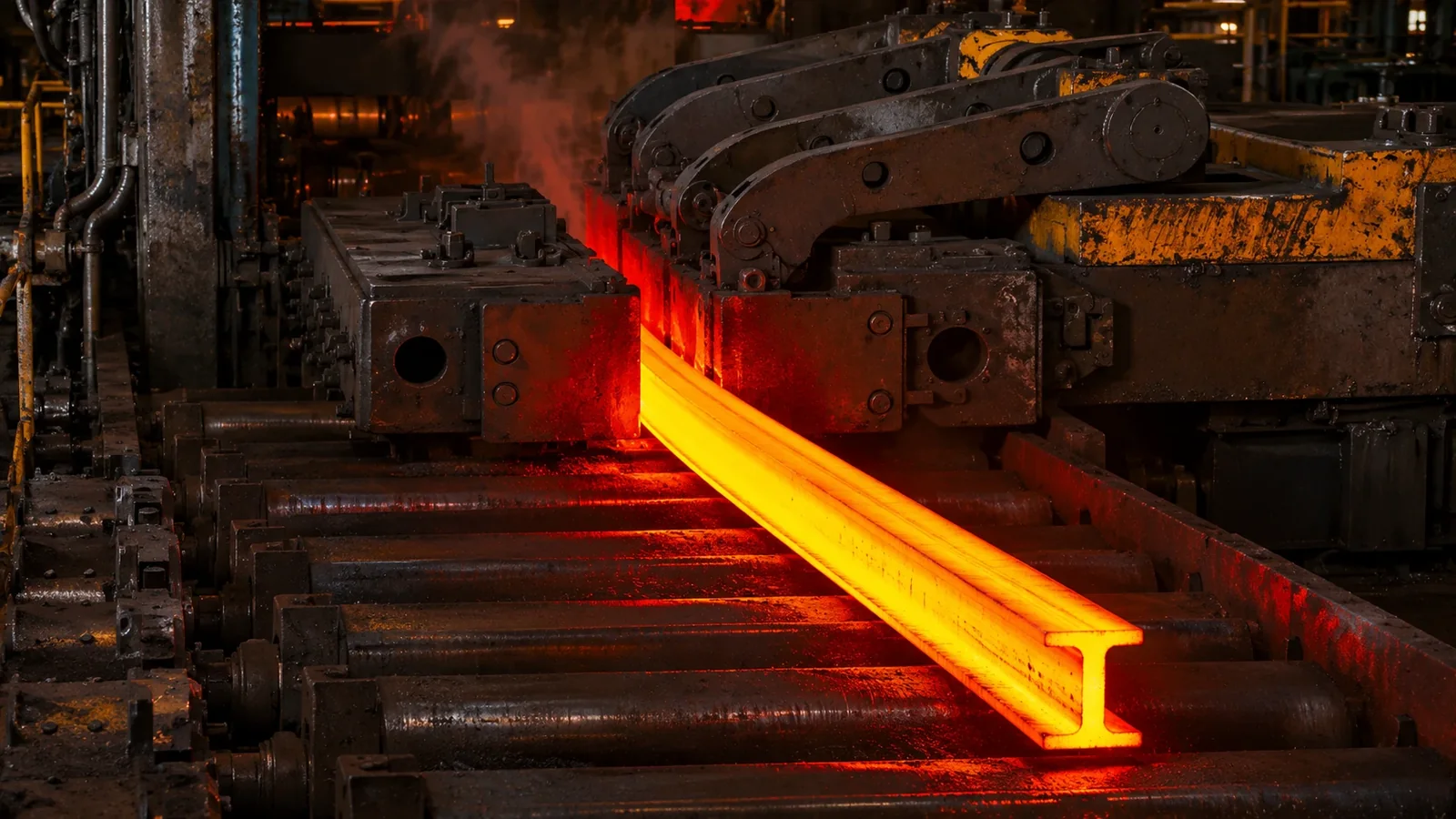
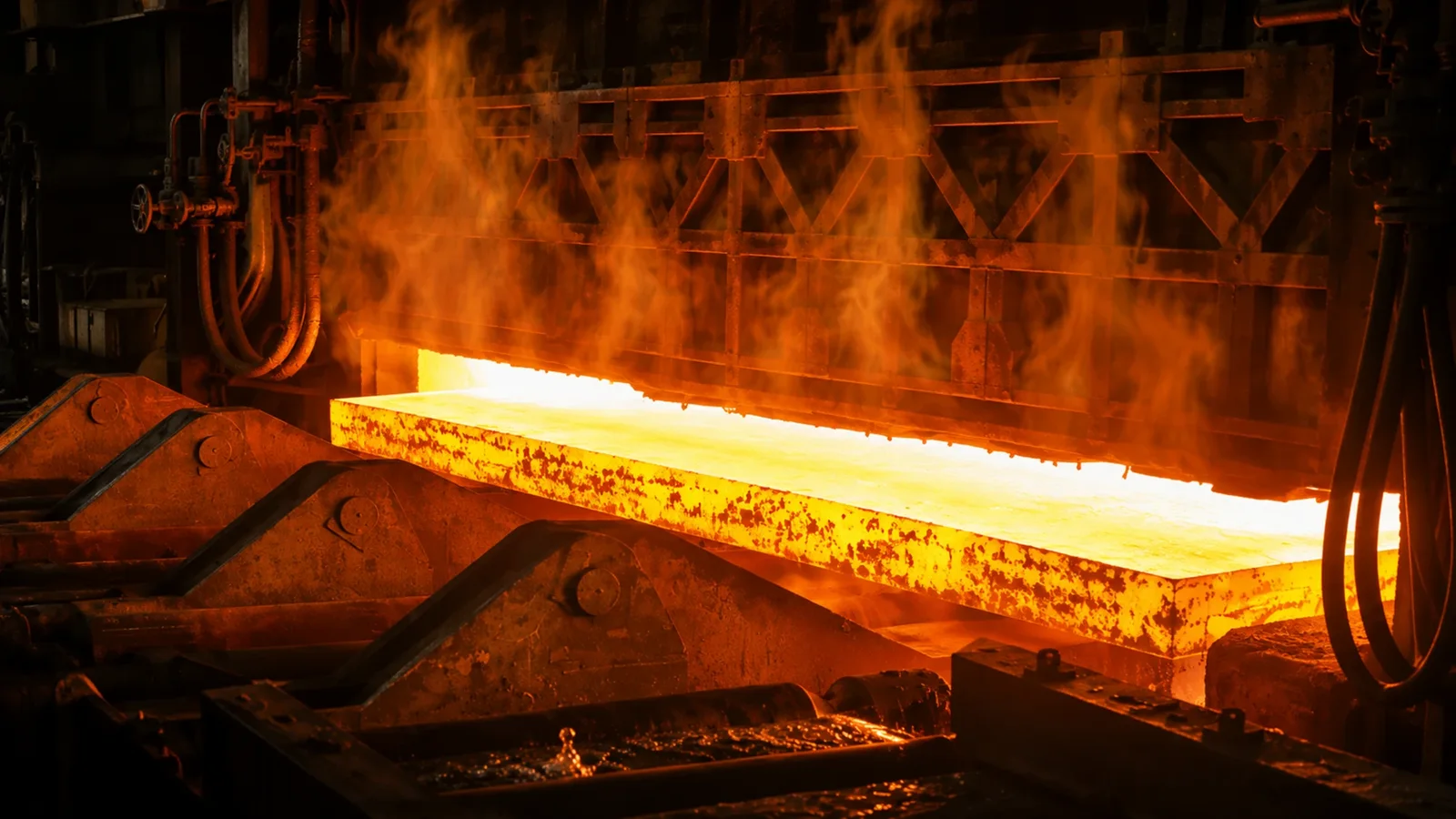
Fine alignment between the continuous caster output and the rolling mill reheating furnace input. Multi-objective optimization makes the most of the heat in hot slabs and billets without compromising urgent orders, reducing specific natural gas consumption and CO₂ emissions.
Objective Hierarchy: Delivery, Downtime, Mixsteel, and Hot Volume
The optimization is lexicographic: first it minimizes delivery delays, then downtime, then mixsteel losses, and only then maximizes the hot-charged volume. Over a 15-day horizon, the result was 12.2% of the volume hot charged, without moving ahead of delivery dates.
Gas Consumption and CO₂ Emissions (Energy Efficiency)
Better furnace occupancy and shorter billet reheating time reduce gas consumption and CO₂ emissions, and integration with demand and real-time operations keeps the plan current.
Measured impact: 12.2% of total volume hot charged, without overriding due dates and stops in the priority order.
Hot Rolling, Section Rolling, and Integrated Mini-Mill Planning (Rolling Mill Scheduling)
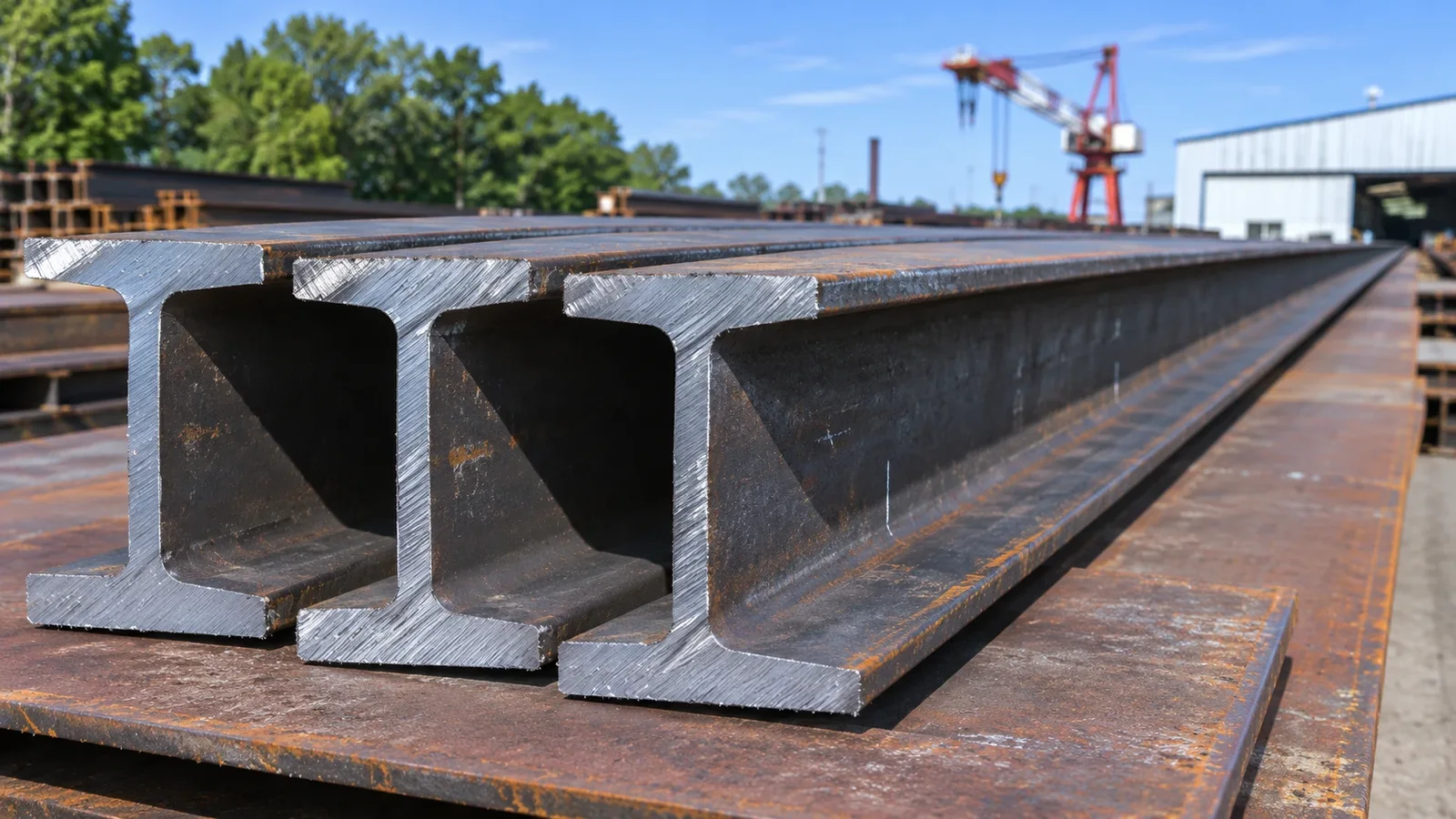
Rolling campaign scheduling that optimizes roll life, minimizes stand change (roll change) stops, and balances stockout risk by SKU against the mill’s nominal productivity.
Profile Rolling: Families, Roll Consumption Limits, and Stand Changes
The digital twin groups product families, respects roll consumption limits and gauge transitions, and models stockout risk. In two profile rolling mills, there were fewer stand changes and production closer to the plan, with 80.5% adherence to the plan in one of them.
Mini-Mill Rolling: Gauges, Campaigns, and Hot Furnace (MILP and Heuristics)
For minimills, a MILP gauge-campaign model combines heuristics and local search and answers in about five minutes on real scenarios. In the integrated steel shop and rolling planning case, stand changes fell 13.5% per month.
Measured impact: 13.5% fewer stand changes per month in a mini-mill section rolling line, raising OEE and plan adherence.
Capacity Plan, Digital PCP, and Steel S&OP (Capacity Planning)
The conversation between sales, production planning, maintenance, and operations needs to start from the same capacity reference. Without it, each area works with a different version of the truth.
Digital PCP: Order Sequencing from D+0 to the Full Backlog
Orders are sequenced from the current day through the entire backlog, reducing setup time and cost, improving on-time delivery, and maximizing production.
Capacity Plan and Maintenance Allocation (Budget and Rolling Forecast)
The plan can be rolling, from the current month to year-end, or annual, for the budget. Maintenance is allocated by date, duration, and type, against commercial constraints.
What-if Scenarios and Comparison across Sales, PCP, and Operations
The team generates and compares scenarios with explicit assumptions and chooses by impact on volume, deadline, and cost, not by each area’s intuition.
Comparison: traditional approach vs. Enacom Planning Digital Twin (Gemminus)
How each approach handles the criteria that define the quality of steel production planning.
Operating criterion
Spreadsheets and manual heuristics
Generic off-the-shelf APS
Enacom Digital Twin (Gemminus Platform)
Constraint modeling
Based on the individual scheduler’s experience
Standardized rules; requires simplifying the mill
Faithful to the mill’s real metallurgical, thermal, and physical rules
Replanning time (S&OE)
Hours or days to rebuild the schedule
Slow and rigid when unexpected breakdowns occur
Seconds to a few minutes to recalculate complete scenarios
What-if simulation
Not feasible at the pace of daily operations
Limited to preset parameters
Side-by-side comparison of multiple scenarios (cost, margin, and due date)
Technology integration
Isolated from corporate systems
Often requires replacing systems and a long rollout
Works alongside existing ERP, MES, and PIMS, via API
Return focus
Keeping the routine
IT standardization
Capacity expansion without CAPEX and direct loss reduction
How the Gemminus Platform fits into your mill’s routine without replacing your legacy systems
Our solutions do not compete with your ERP or MES: they add the prescriptive mathematical intelligence layer that was missing between shop floor data and executive decisions. Steel applications run on the Gemminus Platform, in the cloud.
The data base follows the Lakehouse model in Bronze, Silver, and Gold layers, with data-contract governance (ODCS): each variable has its unit, valid range, frequency, and quality agreement defined before any pipeline. In production, the model manages more than 1,100 time series from a mill.
Decision and constraint mapping: we work with process engineers, metallurgists, and the production planning team to translate business rules, thermal limits, and physical bottlenecks into precise mathematical models.
Seamless integration: we connect the Gemminus Platform to the ERP (such as SAP), the MES, and process historians (PIMS) to automatically read the order book, intermediate inventories, and asset status.
Scenario comparison in the specialist’s hands: the planner does not get a black box. They see the base scenario side by side with optimized scenarios, change weights (for example, gas savings or a strategic customer’s lead time), and approve the plan with confidence.
Pilot before scaling: we validate in known scenarios, compare with history, and only then widen the scope.
How to Start: Decision Diagnosis, Validated Pilot, and Scale (Implementation Methodology)
A steel Digital Twin project starts from the decision that most limits results and moves in short stages, always comparing the proposed plan with what the operation actually did.
1. Diagnosis of the decision and the data
With the team, we map the decision, metallurgical rules, process times, and the data available in the MES, APS, and ERP, and define success indicators before any modeling.
2. Modeling and validation with history (Backtesting)
We replay known periods of the mill and compare the model’s plan with what was done, so the specialist trusts the rules and assumptions before seeing the first new plan.
3. Pilot in assisted operation
The system generates plans and alerts alongside the routine, with the planner in control. Rules and constraints are adjusted with what the operation teaches.
4. Scale to the other stages
With the first decision stable, we extend the twin to the next stage of the chain, from the steel shop to the yard and rolling, on the same data base and rules.
Frequently asked questions about optimization and Digital Twins in steel
What is a Digital Twin in steel?
It is a computational representation of the mill that reproduces metallurgical rules, times, and equipment constraints. With it, the team simulates decisions, compares scenarios, and generates plans before executing on the shop floor.
How does Enacom’s Planning Digital Twin integrate with the SAP and MES systems already used at the mill?
The Gemminus Platform works as an intelligence layer attached to the plant’s current architecture. It consumes sales order, inventory, and equipment availability data from the ERP (such as SAP) and the MES/PIMS, via APIs or staging databases, runs the mathematical optimization in the cloud, and returns the optimal sequence, validated by the planner, for execution on the shop floor.
What is the practical difference between traditional APS software and Enacom’s solutions for steel production planning?
Traditional APS software uses generic heuristics designed for discrete manufacturing and often fails to handle the particulars of continuous and semi-continuous process industries, such as chemical transitions between heats, thermal losses in torpedo cars, or overhead crane constraints in slab yards. Enacom builds custom mathematical models on the Gemminus base so that the mill’s real metallurgical constraints are part of the plan.
How does mathematical optimization help expand mill capacity without CAPEX?
In most steel shops and rolling mills, the apparent production limit does not come from equipment mechanical capacity but from synchronization losses: waiting times between stages, excessive roll and stand changes, duplicated yard moves, and off-spec material or material with no order. By optimizing sequencing globally, the mill raises throughput (tons per hour) and hot charging with the same physical assets. In a paper presented at AISTech 2024, monthly steel shop output rose by about 1% with no infrastructure investment.
How long does it take for a steel optimization solution to reach assisted operation?
The Gemminus Platform’s technology building blocks shorten development. Specific projects, such as a Heat Formation tool, a Yard Optimizer, or a Rolling Sequencer, are validated with the mill’s historical and real data and go through a pilot in assisted operation with the planning team before the scope is widened. The timeline depends on the chosen decision and data availability, and is set during the initial diagnosis.
What results have been measured?
Measured results include the drop from 15 to 6 yard moves per load, 17% less steel with no customer order in heat formation, 13.5% fewer stand changes per month, and 12.2% of the volume hot charged. The conditions of each measurement are in the cases.
Go deeper into Steel solutions, publications, and cases
From research to operations: cases and scientific papers
Each front pairs the case where the optimization ran in operation with the papers in which Enacom's team publishes the methods behind that front at technical conferences and in scientific journals. Practical proof and scientific proof, side by side.
Steel shop and scheduling
Case in operation
Heat formation17% less steel with no customer order in steel shop heat formation