
AISTech 2026, Pittsburgh, Pennsylvania (USA)
Hot Charge Optimization in Mini-Mills: Aligning Thermal Efficiency With Market-Driven Throughput
An optimization framework that synchronizes continuous casting, billet buffers, and three rolling lines to balance reheating energy savings and market-driven throughput.
Industrial application (Hot charging and billet reheating)
Taking the billet to the reheating furnace while still hot saves energy, but it competes with market-driven production targets. The paper turns this conflict into a decision the planner manages.
From the mathematical concept to the business gain
- Multi-objective optimization
- Balance reheating energy cost and customer demand, with the trade-off between them visible to the planner.
- Synchronizing casting, buffers and rolling
- Continuous casting, the intermediate billet buffer and three rolling lines are scheduled together so the billet reaches the furnace hot.
- Line-specific constraints
- Minimum furnace batch sizes, variable setup times and dynamic priority rules enter the plan, without relying on manual heuristics.
Result: In the related case, the plan sent 12.2% of the volume to hot charging in a real 15-day scenario, even with heat as the last of four priorities and a single eligible line.
See the case: Hot chargingApplications in Steel
Enacom executive summary, based on the paper and the related projects.
Abstract
In Mini-Mill operations, hot charging delivers billets to the rolling mill within few hours of casting, providing considerable energy savings but requiring balance with market-driven throughput targets. An optimization framework synchronizes continuous casting, billet buffers and three rolling lines while enforcing line-specific constraints such as minimum furnace batch sizes and variable setup times and dynamic priority rules. A digital twin optimization engine evaluates candidate schedules, allowing planners to manage the tradeoff between reheating energy cost and customer demand without manual heuristics.
Original abstract, published in English.
Keywords
Digital TwinHot RollingMulti-objective OptimizationSteelmakingEnergy Efficiency
View the publication on OnePetro
Full paper
Full text of the paper.
Introduction
According to the International Energy Agency (IEA)1, one of the main trends related to the steel industry is associated with the development of more sustainable steel production routes. In this context, the steel sector alone is responsible for approximately 7% to 11% of global carbon dioxide emissions, which highlights the relevance of this industry in the climate change debate.
An alternative for reducing greenhouse gas emissions is the use of small-scale steel plants that employ scrap as the main raw material and operate electric arc furnaces (EAF), commonly known as Mini-Mills. The electric arc furnace presents an average emission of approximately 270 kg of CO₂ per ton of steel produced, whereas integrated plants based on blast furnaces, which do not use scrap, can reach emissions on the order of 1,990 kg of CO₂ per ton2.
The main strategies for reducing emissions in the steel industry include the use of green hydrogen for iron ore reduction, the adoption of electric arc furnaces powered by renewable energy sources, and carbon capture and storage technologies3. However, these strategies are strongly related to the architecture of the production process, requiring significant investments in infrastructure and equipment replacement, which may limit their short-term applicability.
Another line of action for carbon emission mitigation is associated with industrial operation planning and optimization, aiming to reduce energy consumption and environmental impact without profound structural changes, with potential of these approaches to achieve both economic and environmental benefits4.
In this context, the present work proposes a methodology to reduce the energy costs associated with the reheating furnace, which is used to heat the steel slab before its transformation into a finished product. The methodology is based on the optimization of hot charging, enabling a reduction in the consumption of fuel gas used in the reheating process and, consequently, in the associated emissions.
Discussion
1. Production Planning
Due to physical space constraints and the costs associated with inventory holding, it is desirable for products to be stored for the shortest possible time after manufacturing. The most efficient strategy in this regard is to produce items only after the confirmation of a sales order, an approach known as make-to-order. Although this strategy minimizes inventory levels, it tends to significantly increase customer lead times and to hinder the economic feasibility of small-batch production, especially in industrial environments characterized by complex processes and high setup times.
As an alternative, companies seek a balance between reducing customer response time and limiting the capital tied up in inventory. In this context, the concept of Sales and Operations Planning (S&OP) stands out, as it aims to align production planning with the expected market demand. S&OP defines production volumes based on the analysis of historical product consumption, taking into account seasonality patterns, market trends, and demand variability.
Based on this information, it becomes possible to establish more appropriate inventory levels to balance product availability, customer service level, and profitability. In this way, S&OP contributes to optimizing the relationship between a product’s ease of commercialization and the profit associated with its sale, seeking to maximize the economic value of inventory while simultaneously reducing operational and financial risks.
2. Hot rolling
In Mini-Mill steel plants, metallic scrap can be melted in electric arc furnaces and solidified in the form of steel billets, which can then be sent directly to the rolling and finishing stages. When this integration occurs without the need for intermediate reheating, the process known as hot charging takes place. Under this condition, the billet is processed while still at a high temperature, resulting in a significant reduction in the consumption of fuel gas used in reheating furnaces, as well as a decrease in the need for intermediate inventories of cast steel.
However, in industrial practice, the full application of hot charging is limited by several operational factors. Among them, the differences between the production rates of the casting and finishing stages stand out, as well as the existence of priority products that are already available in inventory and must be processed to meet immediate demand. These constraints make it infeasible, in many scenarios, to apply hot charging to the entire planned production.
Given this context, there is a need for planning and optimization methods that maximize hot charging whenever operational conditions permit. The application of optimization techniques enables more efficient coordination between production stages, seeking to reduce energy consumption and associated costs without compromising demand fulfillment and the constraints of the production system.
3. Digital twins
Digital twins are technologies that enable a virtual representation of physical systems, allowing the replication of the dynamic behavior of industrial plants with a high degree of fidelity. These virtual representations are widely used for simulation purposes, scenario analysis, and decision support. In the steelmaking context, a digital twin can model complex phenomena such as productivity nonlinearities, operational variations, setup times, equipment changeovers, and scheduled shutdowns for preventive maintenance.
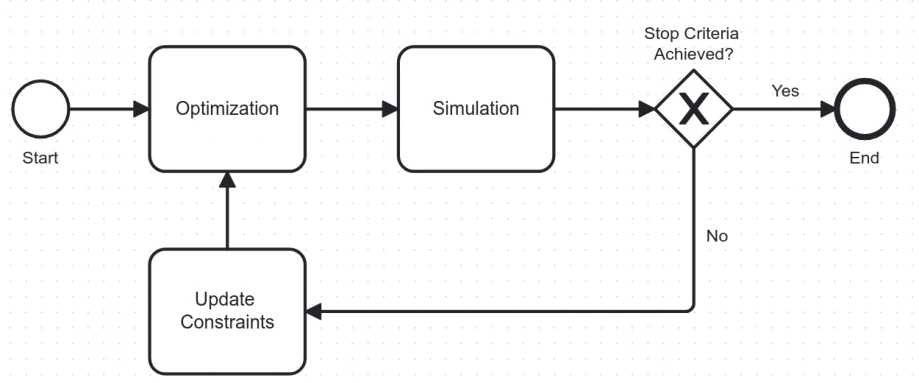
In the field of optimization, the use of digital twins characterizes a new methodological paradigm in which the problem is decomposed into two distinct stages: a simulation stage and a decision-making stage. In this approach, the digital twin is responsible for capturing and evaluating the nonlinear behavior and operational constraints of the production system, while the optimization algorithm operates on a reduced set of decision variables, using the simulation results to assess the performance of each candidate solution.
This separation makes it possible to simplify the formulation of the optimization problem, since the nonlinearities and complexities of the process are implicitly handled by the simulation model, thereby reducing the need for excessively complex mathematical formulations. This characteristic makes the approach particularly suitable for multi-objective optimization problems, in which multiple conflicting criteria—such as cost, energy consumption, service level, and environmental impact— must be considered simultaneously.
Figure 01 presents the flowchart of the use of digital twins applied to multi-objective optimization, illustrating the interaction between the solution generation module, the digital twin responsible for simulating the production system, and the mechanism for evaluating objective functions and constraints.
4. Optimization
Once the relationship between simulation and optimization has been established through the digital twin, it becomes necessary to formally characterize the proposed optimization problem. This is a complex problem, subject to multiple operational constraints and several potentially conflicting objective functions, as described below.
4.1 Lead time constraints
Lead time constraints are associated with the minimum and maximum times that must be respected throughout the casting and rolling processes. Among the main constraints in this group are: the time required for gauge changes, the time needed to replace the tundish in continuous casting, and the maximum allowable time between the exit of steel from the melt shop and its entry into the rolling mill for the process to be characterized as hot charging.
4.2 Downtime constraints
This set of constraints is related to interruptions in the production process. The main ones include: scheduled shutdowns previously registered in the system; mandatory shutdowns resulting from the sequential production of incompatible steel grades; constraints that prohibit shutdowns during the processing of certain steel types; and limitations associated with restarting melt shop operations after a shutdown, depending on the class of steel to be produced.
4.3 Steel mix constraints
Steel mix constraints define the sequencing rules for different steel grades in the casting process. Some steels cannot be produced sequentially due to incompatibility issues, while others can be sequenced without impacting quality. There are also intermediate cases in which sequential production is allowed but results in losses associated with the generation of lower-quality steel during transitions between alloys.
4.4 Productivity constraints
Productivity constraints are related to the time required to produce one ton of steel, considering the specific characteristics of each material type. These constraints reflect metallurgical differences, operational limitations, and variations in process performance depending on the steel grade being produced.
4.5 Objective functions
The objective functions considered in this work have different natures and units of measurement, which makes their direct aggregation into a single scalar function infeasible. Therefore, a multi-objective optimization approach with lexicographic ordering was adopted, in which the objectives are prioritized according to their operational importance, following the hierarchy below:
- Minimize delivery delays to the rolling processes and to sales fulfillment;
- Minimize the total downtime of the production system;
- Minimize the production of intermediate steel resulting from undesirable mixtures;
- Maximize the volume of hot-charged production.
4.6 Solution strategy
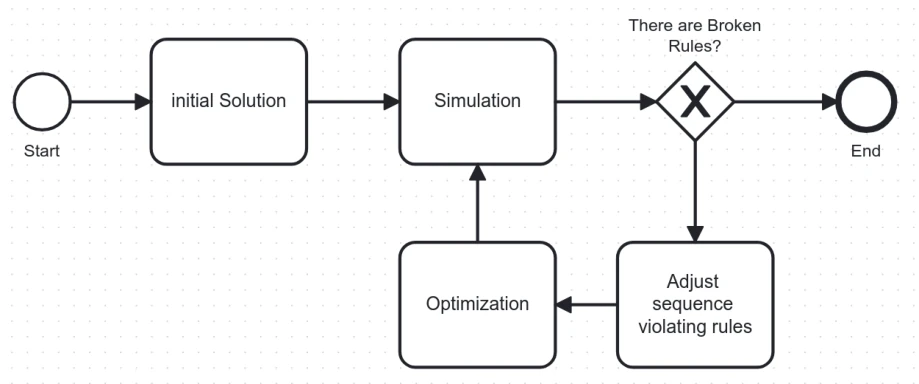
The adopted solution strategy is based on an iterative approach integrated with simulation through the digital twin. Initially, a feasible reference solution is defined and evaluated in the simulation stage to verify compliance with operational constraints. If violations are identified, the solution is classified as undesirable, and a local search procedure is applied to modify the production sequencing to eliminate or reduce constraint violations.
This process is repeated iteratively, exploring the neighborhood of the current solution, until the best possible solution is found according to the lexicographic ordering of the objective functions. Figure 02 presents the flowchart of the solution strategy used, highlighting the interaction between solution generation, simulation, and objective evaluation.
5. Architecture
In addition to the optimization core, the proposed system incorporates additional stages that are essential to ensure its proper operation and the quality of the generated solutions. These stages comprise data pre-processing and post-processing procedures, which structure the model inputs and enable an adequate evaluation of the obtained results. The software architecture is described below.
5.1 Demand conversion
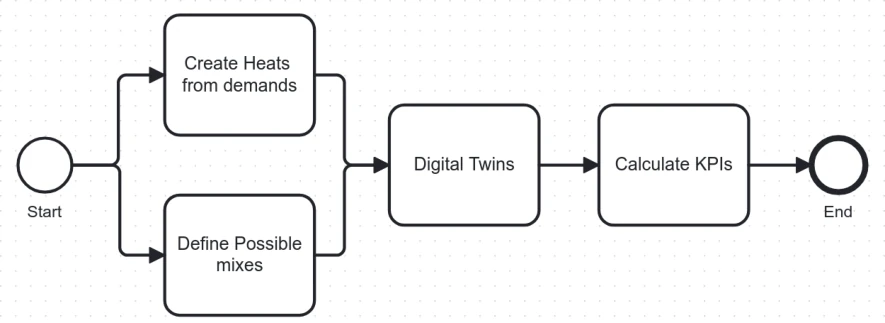
Initially, the system receives demands from three distinct rolling mills. These demands are then converted into production heats, taking their respective delivery dates into account. This procedure enables the grouping of orders with the same steel grade and dimensions, as well as the identification of priority groups, which directly influence sequencing and optimization decisions.
5.2 Generation of the valid steel mix list
The system receives as input a list of steel mix combinations that are permitted from a metallurgical and operational standpoint. Based on this information, a list of valid transitions between steel grades is constructed, defining the admissible moves in production sequencing. This list is used directly in the optimization stage, restricting the search space to feasible solutions.
5.3 Optimization stage
With the pre-processed information, the optimization module described in the previous section is executed using a digital twin to simulate the behavior of the production system. At this stage, different production sequences are evaluated with respect to compliance with operational constraints and performance relative to the defined objective functions.
5.4 Performance indicator (KPI) calculation
After identifying the best feasible solution, key performance indicators (KPIs) are calculated to assess the quality of the obtained solution. Among the main KPIs considered in this work are inventory occupancy level, average and maximum demand delay, the volume of hot-charged production, and the additional delay generated by infeasible steel mix constraints.
Figure 3 presents the overall architecture of the proposed software, highlighting the pre-processing stages, the digital twin– based optimization module, and the post-processing stage for performance indicator generation.
6. Results
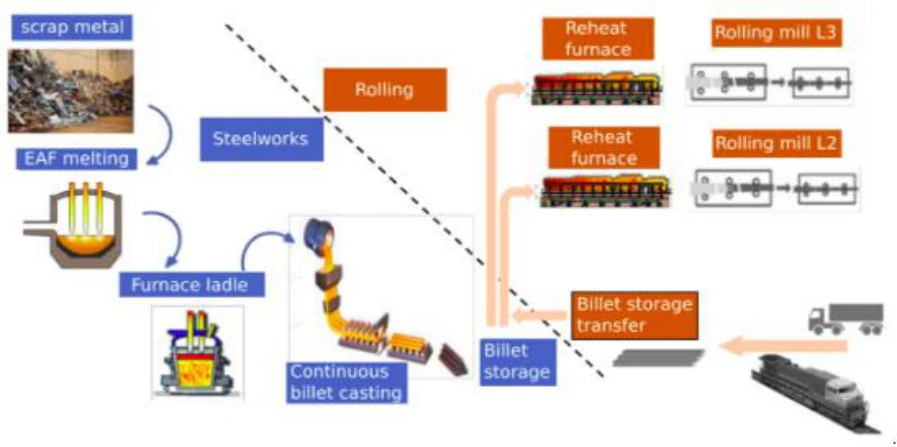
To validate the proposed optimization method, real operational scenarios from the Cosigua steel plant, located in Brazil, were evaluated. This facility is a Mini-Mill that uses exclusively metallic scrap as raw material for steel production and operates with one melt shop and three rolling lines. Among these, only one rolling mill is technically capable of operating with hot charging. Figure 04 presents a simplified schematic of the analyzed plant5.
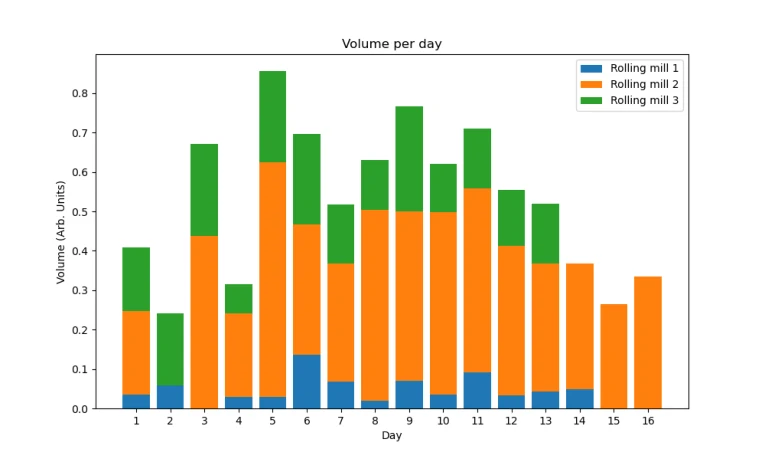
The numerical experiments consider a 15-day planning horizon, during which the three rolling mills must be supplied by the melt shop. In this scenario, the second rolling mill was defined as the only one eligible for hot charging. The distribution of demands over the planning horizon is shown in Figure 05.
The application of the optimization method resulted in an average hot charging rate of 12,2% over the entire analyzed period. Figure 06 illustrates the daily evolution of hot charging, highlighting the variability of this indicator throughout the planning horizon.
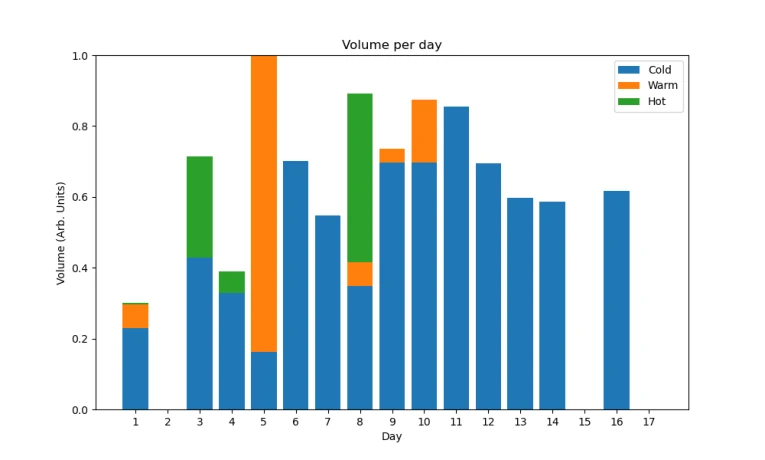
It can be observed that, in certain periods—especially in the final days of the analyzed scenario—the reduction in rolling mill demand makes hot charging infeasible. This occurs due to an imbalance between the production rates of the melt shop and the rolling mill, since the melt shop operates at a higher production rate, resulting in excessive time intervals between casting and rolling.
In addition to hot charging, warm charging also plays a relevant role in reducing the energy consumption of the process. For the considered scenario, the melt shop produced the entire demand within 11 days, which means that during these 11 days almost all days exhibited a reduction in gas consumption due to either hot or warm charging. This reduction implies not only a decrease in operational costs, but also a significant contribution to mitigating the environmental impact associated with the production process.
Conclusions
This article demonstrated the advantages of incorporating hot charging as one of the objective functions in the production planning optimization problem of a Mini-Mill steel plant. The obtained results indicate that, even when treated as the lowest-priority objective within the adopted lexicographic ordering, it was possible to achieve an average hot charging rate of 12.2%, contributing to a more energy-efficient and operationally efficient process.
It is worth noting that the potential for hot charging could be even higher in scenarios with greater demand levels. However, the reduction observed at the end of the planning horizon was deliberately maintained in the experiments in order to represent a realistic operational situation and to allow the analysis of the behavior of the proposed method under less favorable conditions.
As future work, the evaluation of a broader set of operational scenarios is proposed, with the aim of analyzing the robustness of the digital twin under different demand patterns and production system constraints. In addition, the inclusion of new objective functions capable of capturing other aspects relevant to industrial planning may expand the benefits obtained and provide greater support for planners’ decision-making. In this way, the advancement of the present work contributes to the development of more efficient and sustainable strategies for steel production.
References
- IEA (2020), Iron and Steel Technology Roadmap, IEA, Paris https://www.iea.org/reports/iron-and-steel-technology-roadmap, Licence: CC BY 4.0
- Zang, G., Sun, P., Elgowainy, A., Bobba, P., McMillan, C., Ma, O., Podkaminer, K., Rustagi, N., Melaina, M., and Koleva, M., “Cost and life cycle analysis for deep CO₂ emissions reduction of steelmaking: Blast furnace-basic oxygen furnace and electric arc furnace technologies,” International Journal of Greenhouse Gas Control, Vol. 128, 2023, pp. 103958, DOI: 10.1016/j.ijggc.2023.103958.
- Gouthami, G., and Vardhan, H., “A Review on Green Steel Technology Manufacturing Towards Net-Zero,” International Journal of Research Publication and Reviews, Vol. 5, No. 12, Dec. 2024, pp. 2240–2243, DOI: 10.55248/gengpi.5.1224.3525.
- Hu, Z., Wei, Z., Sun, H., Yang, J., and Wei, L., “Optimization of Metal Rolling Control Using Soft Computing Approaches: A Review,” Archives of Computational Methods in Engineering, Vol. 28, No. 2, Nov. 2019, pp. 405–421, DOI: 10.1007/s11831-019-09380-6.
- Kolberg, F., Campos, P. H., Henrique, T., Fraga, G., Mendonça, M., Rodrigues, G., Vieira, D., Alvares, B., and Breder, S., “Hot Rolling Optimization of a Mini-Mill Scheduling Considering Metalworking Due Dates and Mixsteel Restrictions,” in Proceedings, May 2024, DOI: 10.33313/388/120.
Want to talk about what you read?
Tell us the challenge in your operation and our team will assess with you where to start.