
AISTech 2025, Nashville, Tennessee (USA)
Generative AI and Digital Twins: A Win-Win Integration for Maximum Productivity in the Steel Industry
How Generative AI assistants integrated with Digital Twins can democratize access to information and answer operational and planning questions in real time.
Industrial application (Generative AI assistants on top of Digital Twins)
The Digital Twin already holds structured, validated operational data. The paper shows how a Generative AI assistant opens that data, in natural language, to whoever needs to decide.
From the mathematical concept to the business gain
- Natural language assistant
- Managers and operators ask in plain language and get the answer right away, without depending on reports or data specialists.
- Validated Digital Twin data
- Answers come from data the twin has already structured and validated, which reduces the risk of unfounded answers.
- Democratized information
- Planning, operations and management consult the same source for operational and planning questions.
Result: Operational information available in real time to more people, from the same data that supports planning.
Gemminus PlatformApplications in Steel
Enacom executive summary, based on the paper and the related projects.
Abstract
The steel industry is at the forefront of leveraging digital technologies to enhance operational efficiency and productivity. Among these technologies, Digital Twins have emerged as a pivotal tool for real-time monitoring and control, historical performance analysis, simulation, optimization and planning. This paper explores the integration of Generative AI (Gen AI) Assistants with Digital Twins, highlighting the transformative benefits and challenges of this innovative approach. Key advantages include democratizing access to information, enabling real-time answers to a variety of operational and planning questions, leveraging structured and validated data available on the Digital Twins for accurate insights.
Original abstract, published in English.
Keywords
natural languagedigital twinreal time systemdeep learninggenerative aiassistantmachine learningiron & steel technologyinformation
View the publication on OnePetro
Full paper
Full text of the paper. Version presented at ABM Week 2024 (26th Automation and IT Seminar, São Paulo, Brazil, September 3–5, 2024); it may differ from the version published in the AISTech 2025 proceedings.
1 Introduction
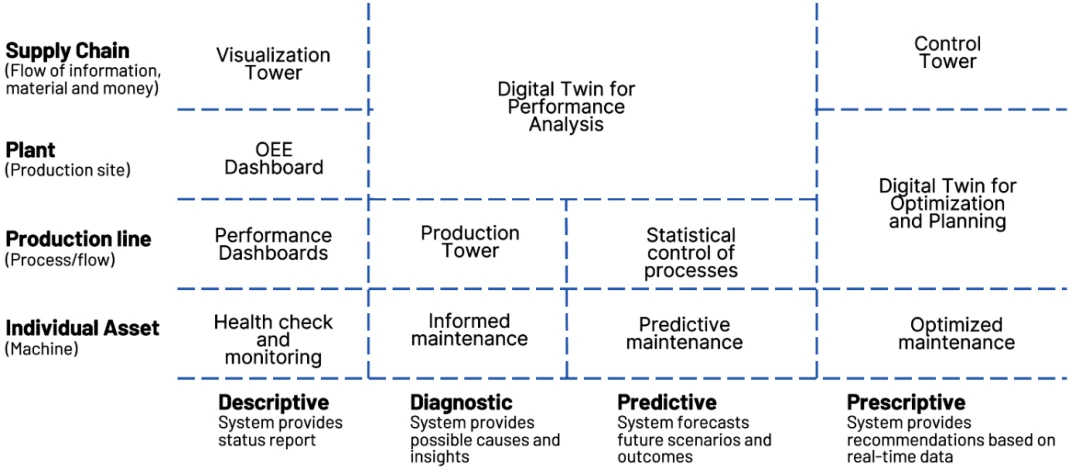
Digital Twins are virtual replicas of physical systems that enable real-time monitoring, optimization and analysis [1]. These digital representations mirror the state and behavior of their physical counterparts through data collected from sensors and other sources, mathematical modeling of processes and simulations. This continuous data flow, coupled to mathematical modeling of processes (e.g. constraints), allows Digital Twins to provide insights into the operational status, predict potential issues, and simulate different scenarios to optimize performance. In the steel industry, Digital Twins can be used to replicate machinery, production lines, plants, and entire supply chains, enabling precise control and optimization of processes (see Figure 1).
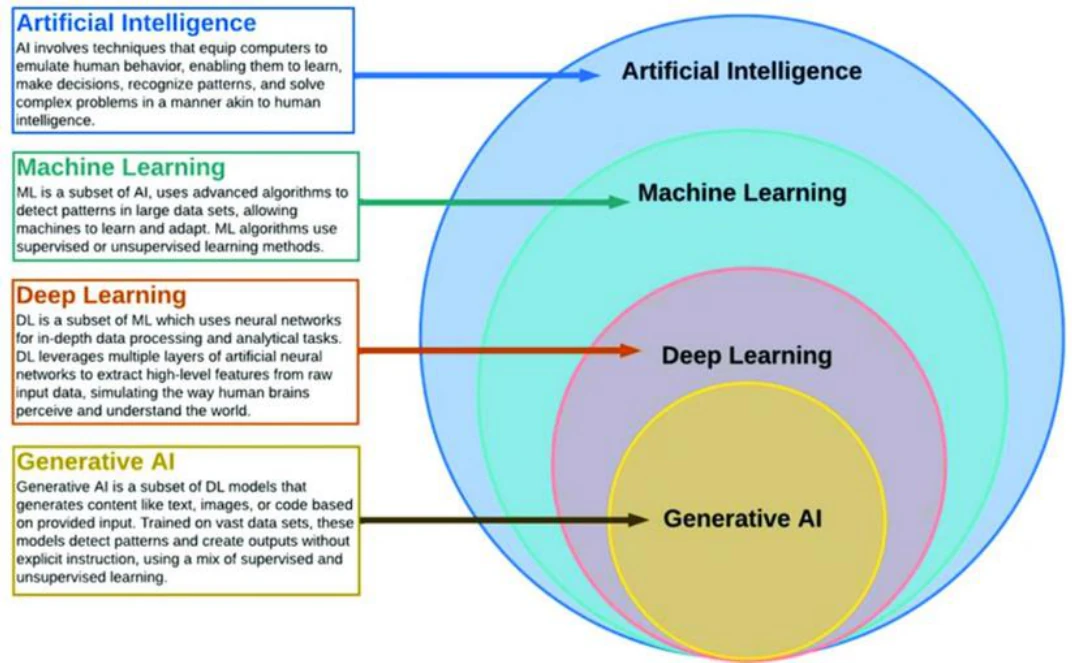
Generative AI [2] refers to a subset of artificial intelligence that uses deep learning algorithms to generate new data based on existing data. These AI models, often powered by deep learning techniques, can create text, images, music, and other types of content (see Figure 2 for more detail).
The primary benefit of Digital Twins is that they empower stakeholders to make informed decisions, anticipate problems before they occur, and explore various operational strategies without disrupting actual production. However, the specialized knowledge required to set up simulation scenarios, calibrate parameters/constraints, and fetch and filter relevant data is often concentrated in the hands of a few experts.
This paper addresses this issue by integrating Generative AI with Digital Twins to create a Digital Twin Tutor (AI Assistant). This AI Assistant can understand the inputs and outputs of Digital Twins, making the technology accessible to all decision-makers via textual prompts.
2 Motivation
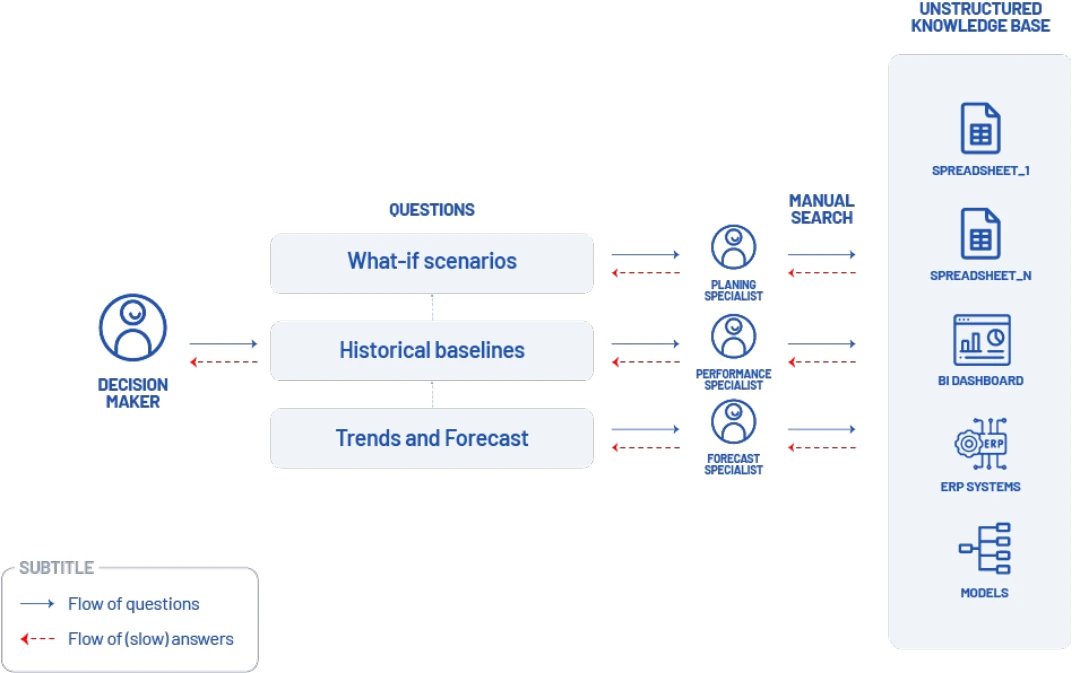
In the dynamic and complex environment of steel manufacturing, timely and accurate information is critical for effective decision-making. However, the current workflow for obtaining answers to crucial operational and planning questions is often inefficient and fragmented. As illustrated in the diagram depicted in Figure 3, decision makers seeking insights into various aspects of operations - such as what-if scenarios, historical baselines, and trends and forecasts - must rely solely on a manual search process conducted by specialists in different domains.
This current workflow dynamics imposes a few challenges to enterprises, such as:
- Fragmented Knowledge Base: The information needed to answer business questions is dispersed across multiple unstructured sources, including spreadsheets, BI dashboards, ERP systems, and models. This dispersion requires specialists to manually search and compile data, leading to delays and potential inaccuracies.
- Specialized Knowledge Bottlenecks: Critical expertise is concentrated in the hands of planning, performance, and forecast specialists. These individuals must interpret and extract relevant data, creating a bottleneck that slows down the flow of information and makes the organization heavily dependent on a few key personnel.
- Slow Response Times: The manual search process required to retrieve and analyze data is time-consuming. Managers must wait for specialists to provide answers, which can result in slow response times and hindered decision-making capabilities.
- Inconsistent Data Interpretation: Different specialists may have varying methods of interpreting and presenting data, leading to inconsistencies and potential misunderstandings. This variability can affect the quality and reliability of the information provided to decision-makers.
The integration of a Generative AI (Gen AI) Assistant with Digital Twins presents a solution to these challenges by automating the retrieval and analysis of data [4]. A Gen AI Assistant can interact with Digital Twins to provide real-time, accurate answers to business questions, democratizing access to information and reducing dependency on specialists. Benefits of the AI Assistant and Digital Twin Integration include:
- Centralized and Structured Data: Digital Twins provide a centralized and structured repository of data that accurately mirrors the physical operations. This structured data is continuously updated and validated, ensuring reliability and accuracy.
- Real-Time Insights: The Gen AI Assistant can analyze data from Digital Twins and provide real-time answers to questions, enabling managers to make informed decisions quickly without waiting for manual searches.
- Accessibility for All Decision-Makers: By making the data and insights accessible to all decision-makers, the AI Assistant democratizes information access. This approach empowers a broader range of employees to make data-driven decisions, fostering a more agile and value-oriented organizational culture.
- Consistent and Reliable Information: The AI Assistant ensures consistency in data interpretation and presentation, providing standardized and reliable information across the organization. This consistency enhances the overall quality of decision-making.
By addressing the inefficiencies of the current workflow and leveraging the capabilities of Digital Twins and Gen AI, the integration of an AI Assistant can transform the steel industry’s approach to information management, leading to more efficient, accurate, and timely decision-making processes.
3 Proposed Architecture
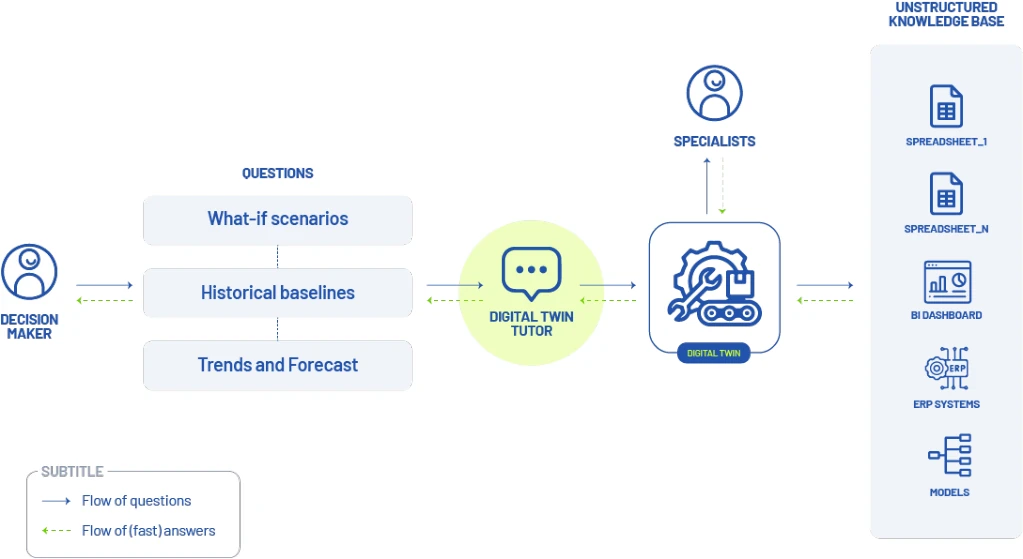
The integration of a Generative AI (Gen AI) Assistant, referred to as the Digital Twin Tutor, with Digital Twins offers a streamlined and efficient architecture for improving decision-making processes within the steel industry. This proposed architecture (see Figure 4), inspired by RAG-LLM model architectures [5, 6], addresses the current challenges of information retrieval and analysis by automating and democratizing access to operational insights.
3.1 Key Components
The proposed architecture improves the flow of information as follows:
- Questions from Decision Makers: Decision makers pose questions related to what-if scenarios, historical baselines, trends, and forecasts. These questions are directed to the Digital Twin Tutor.
- Interaction with Digital Twin Tutor: The Digital Twin Tutor processes these questions, leveraging the structured, processed, simulated and validated data within the Digital Twin. It interprets the inputs and outputs, providing real-time answers and insights.
- Specialists and Digital Twin Interaction: Specialists ensure that the Digital Twin is accurately calibrated and maintained. They input the necessary parameters and constraints to keep the Digital Twin aligned with the physical systems.
- Data Integration from Unstructured Knowledge Base: The Digital Twin consolidates data from various unstructured sources within the knowledge base and generates via scenario simulation and optimization. This integration ensures that the Digital Twin has a comprehensive dataset to generate reliable and accurate insights.
The Digital Twin Tutor enables decision makers to receive immediate answers to their questions, enhancing the speed and efficiency of decision-making processes. By providing access to structured and validated data, the Digital Twin Tutor ensures that valuable insights are accessible to all decision makers, not just a few specialists.
4 Use Case: Integration of Digital Twin Tutor and Digital Twin for Performance Analysis
In this use case, we demonstrate the integration of the Digital Twin Tutor with a Digital Twin for performance analysis. The experiment is set up to analyze productivity, yield, and CO2 emissions across multiple plants over the period from 2019 to 2023. The goal is to utilize the Digital Twin Tutor to provide real-time insights and recommendations for improving overall performance.
4.1 Experiment Setup
- Setting Up the Digital Twin:
- Modeling: The Digital Twin models each plant’s production processes, capturing key variables such as equipment performance, production schedules, and environmental conditions.
- Calibration: Specialists calibrate the Digital Twin using historical and validated data to ensure accuracy in simulating real-world conditions.
- Integration with Digital Twin Tutor:
- The Digital Twin Tutor is configured to interact with the Digital Twin, providing an interface for decision makers to query and receive insights.
- The Tutor leverages machine learning algorithms to analyze the integrated data and generate insights related to productivity, yield, and CO2 emissions.
- Performance Metrics Analysis:
- Productivity Analysis: The Digital Twin Tutor analyzes the productivity data to identify trends, peak performance periods, and potential bottlenecks.
- Yield Analysis: The Tutor examines yield data to identify factors contributing to production losses. It suggests process adjustments and quality control measures to improve yield percentages.
- CO2 Emissions Analysis: The Tutor assesses CO2 emission data, correlating it with production activities. It offers insights into emission reduction strategies and evaluates the impact of different operational changes on environmental performance.
4.2 Example Queries and Insights
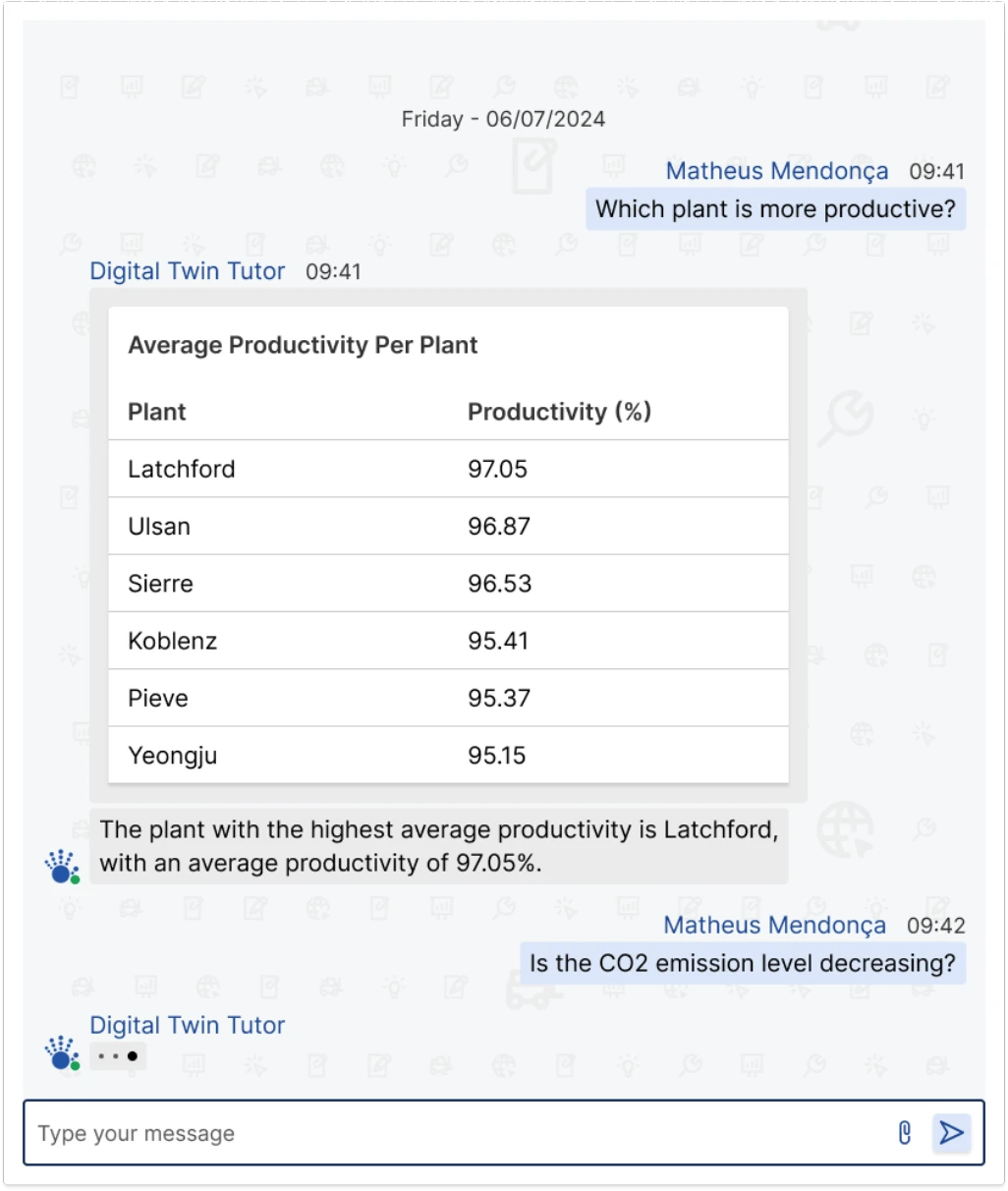
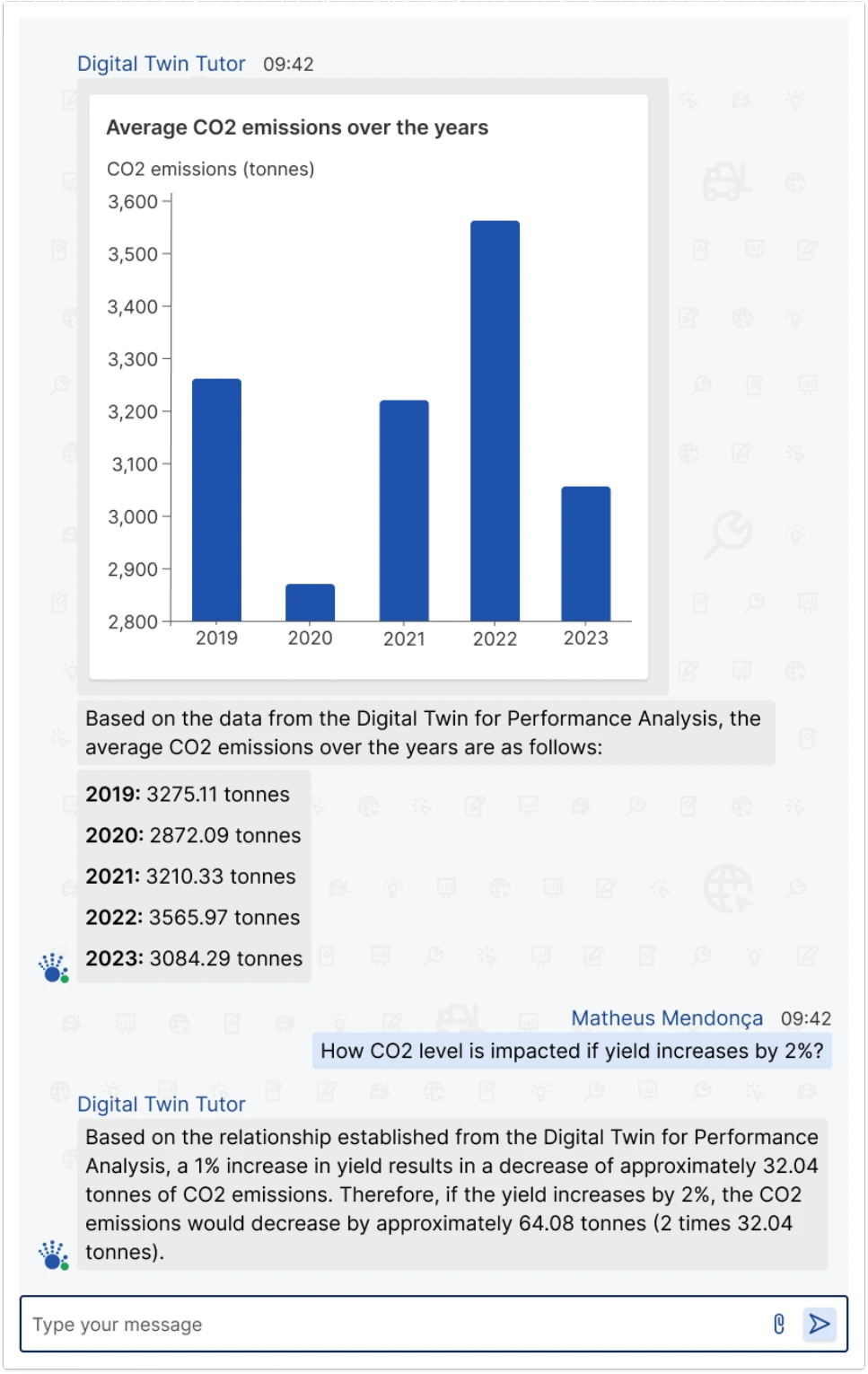
The following prompt example is a real interaction between a human and the Digital Twin Tutor. Note the broad nature of the questions and the ability of the proposed architecture to answer them.
5 Conclusion
The integration of a Generative AI (Gen AI) Assistant with Digital Twins marks a pivotal advancement for the steel industry, offering substantial benefits in terms of operational efficiency, productivity, and decision-making capabilities. By democratizing access to critical insights, the Digital Twin Tutor empowers a broader range of decision makers to make informed choices in real-time. This integration also leverages the structured and validated data from Digital Twins, ensuring reliable and accurate insights that are essential for optimizing production processes, predictive maintenance, and overall operational efficiency. The ability to provide real-time answers and perform advanced simulations enhances collaborative decision-making and significantly reduces reliance on specialized knowledge.
Furthermore, this integration addresses the challenges associated with working with unstructured data, mitigating issues of data quality and the high costs of curation. The use case of performance analysis demonstrated how the Digital Twin Tutor can drive improvements in productivity, yield, and environmental performance by providing actionable insights based on comprehensive data from multiple plants over several years. By adopting this innovative architecture, the steel industry can overcome current inefficiencies and bottlenecks, ensuring a safer and more efficient working environment.
Acknowledgments
The authors would like to thank the support of FAPEMIG, CNPQ and CAPES for sponsoring this work.
References
- Tao F, Xiao B, Qi Q, Cheng J, Ji P. Digital twin modeling. Journal of Manufacturing Systems. 2022 Jul 1;64:372-89.
- Chang Y, Wang X, Wang J, Wu Y, Yang L, Zhu K, Chen H, Yi X, Wang C, Wang Y, Ye W. A survey on evaluation of large language models. ACM Transactions on Intelligent Systems and Technology. 2024 Mar 29;15(3):1-45.
- Popova Zhuhadar, L. A Comparative View of AI, Machine Learning, Deep Learning, and Generative AI. Available online: https://commons.wikimedia.org/wiki/File:Unraveling_AI_Complexity_- _A_Comparative_View_of_AI,_Machine_Learning,_Deep_Learning,_and_Gen erative_AI.jpg (accessed on 07 June 2024).
- Bariah L, Debbah M. The interplay of AI and digital twin: Bridging the gap between data-driven and model-driven approaches. IEEE Wireless Communications. 2024 Jan 31.
- Ding Y, Fan W, Ning L, Wang S, Li H, Yin D, Chua TS, Li Q. A Survey on RAG Meets LLMs: Towards Retrieval-Augmented Large Language Models. arXiv preprint arXiv:2405.06211. 2024 May 10 6. Li M, Wang R, Zhou X, Zhu Z, Wen Y, Tan R. ChatTwin: Toward Automated Digital Twin Generation for Data Center via Large Language Models. InProceedings of the 10th ACM International Conference on Systems for Energy-Efficient Buildings, Cities, and Transportation 2023 Nov 15 (pp. 208-211).
Want to talk about what you read?
Tell us the challenge in your operation and our team will assess with you where to start.