
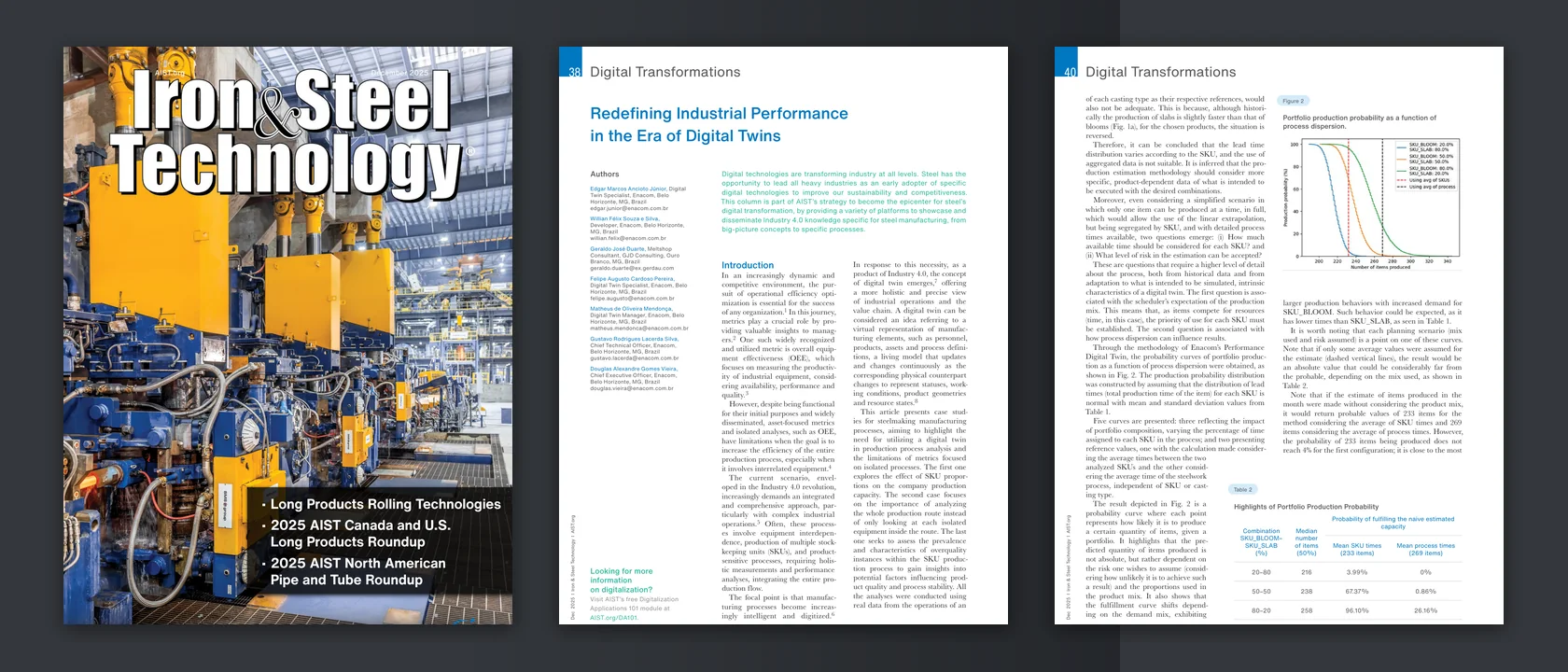
Enacom had its technical paper “Redefining Industrial Performance in the Era of Digital Twins” published in the December 2025 issue of Iron & Steel Technology, the magazine of the Association for Iron & Steel Technology (AIST). The text ran in the Digital Transformations column, the space where AIST gathers content on the digital transformation of steelmaking, on pages 38 to 44 of the issue. The original version was presented at AISTech 2025, in Nashville (USA), and published in the conference proceedings.
The challenge: measuring the performance of a flow, not just of each piece of equipment
Metrics such as OEE (overall equipment effectiveness) are widely used, but they look at each asset in isolation. In processes with interdependent equipment, many different products (SKUs), and product-sensitive stages, this kind of metric stops showing what happens across the whole flow.
The approach: the Performance Digital Twin in three case studies
The paper presents three case studies from a steel plant, all using real operating data from an Enacom client, analyzed with the methodology of Enacom’s Performance Digital Twin. The studies show the limits of isolated analyses and how a view of the production flow changes the decision.
- Impact of the product mix on the production target: the estimate by simple average, 269 items for the month, ignores that production time varies by SKU. With probability curves by mix, output proved to depend on the risk accepted and on the portfolio composition: the quantity of 233 items, for example, had a probability below 4% in one mix and reached 96% in another.
- Production route and process times: a machine’s time depends on the path taken. Analyzing the whole route, rather than the equipment in isolation, reversed the choice of which ladle furnace to prioritize and led to a variation of about 2.5% in time.
- Overquality: of 18,457 units produced, 6,797 exceeded the specification, more than a third of the total. The months with the most cases coincided with maintenance outages of one piece of equipment, which points to opportunities for gains in maintenance planning and in mix composition.
Authors and support
The paper is authored by Edgar Marcos Ancioto Júnior, Willian Félix Souza e Silva, Felipe Augusto Cardoso Pereira, Matheus de Oliveira Mendonça, Gustavo Rodrigues Lacerda Silva and Douglas Alexandre Gomes Vieira, from Enacom, and Geraldo José Duarte, from GJD Consulting. The work had the support of FAPEMIG, CNPq, and CAPES.
Read more
See the paper summary and publication details on the Enacom website, the Performance Digital Twin and the solutions for Steel. The paper is also part of the AISTech 2025 proceedings.