
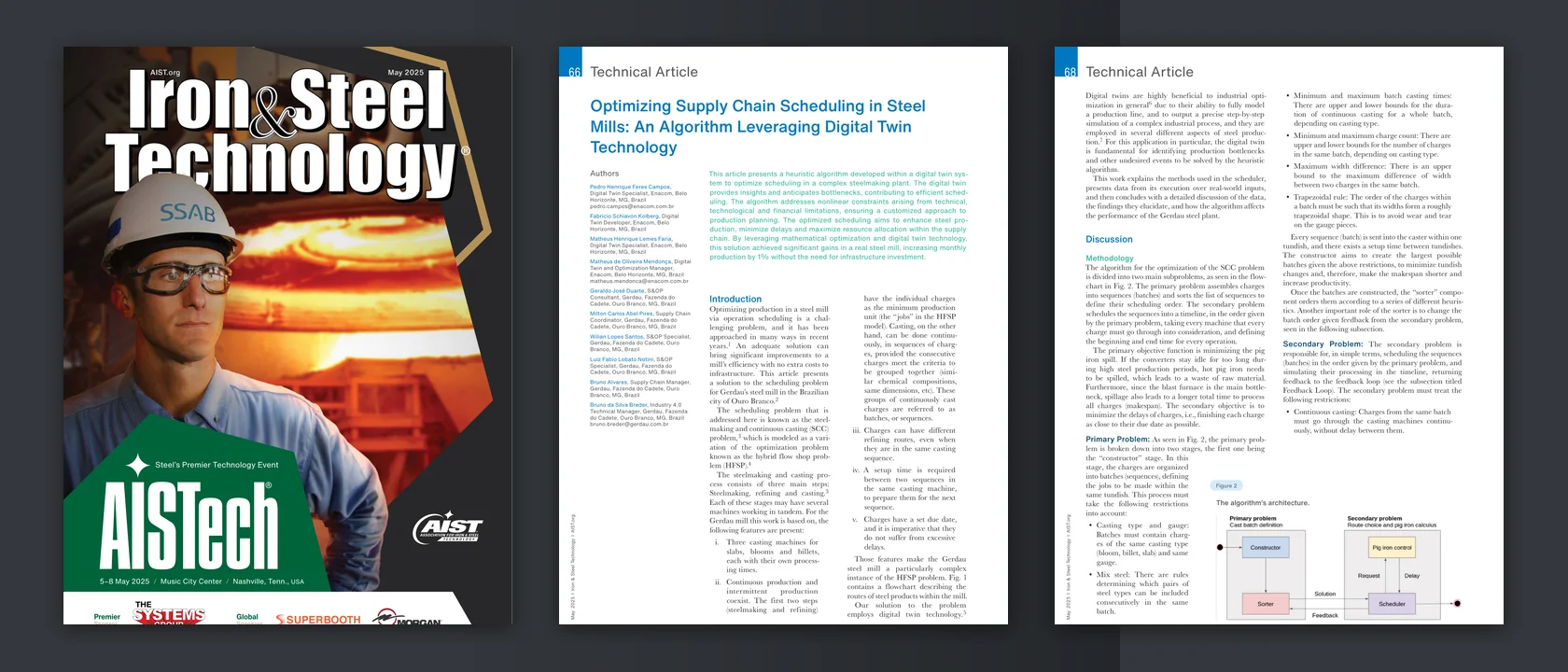
Enacom had its technical paper “Optimizing Supply Chain Scheduling in Steel Mills: An Algorithm Leveraging Digital Twin Technology” published in the May 2025 issue of Iron & Steel Technology, the magazine of the Association for Iron & Steel Technology (AIST) (Vol. 22, No. 5, pp. 66–73). The text is part of the issue’s Digitalization Applications section. The original version was presented at AISTech 2024, in Columbus (USA), and published in the conference proceedings.
The challenge: scheduling steelmaking and continuous casting in a complex mill
The steelmaking and continuous casting scheduling problem is modeled as a variation of the hybrid flow shop. At Gerdau’s Ouro Branco (MG) mill, it combines three casting machines (slabs, blooms, and billets), continuous and intermittent production in the same line, different refining routes, setup times between sequences, and due dates to meet. Since the blast furnace is the main bottleneck, pig iron that has to be spilled wastes raw material and lengthens the total production time.
The solution: a heuristic algorithm inside a Digital Twin
The paper presents a heuristic algorithm developed within a Digital Twin system. The Digital Twin identifies bottlenecks and undesired events, and the algorithm treats them iteratively, with two objectives: first, minimize pig iron spill and, then, minimize charge delays. The problem is split into two parts:
- Primary problem: a constructor assembles the charge sequences within the casting restrictions, and a sorter defines the order in which they will be scheduled.
- Secondary problem: a scheduler allocates the sequences on the timeline, considering routes, maintenance, transit times, and changeovers, while the pig iron control simulates the pig iron level minute by minute and returns to the sorter the events to correct.
Results
- +1% monthly production: in a real mill, the solution increased monthly production by 1%, with no infrastructure investment.
- Near-optimal solution with few attempts: in a six-sequence scenario, where the brute-force method analyzed all 720 possible permutations, the algorithm reached its final solution after analyzing only three.
- Practical run time: in 460 real and realistic test cases, even with more than 1,000 charges the algorithm runs in a little over an hour, while a conservative estimate for brute force, with only 200 charges, exceeds 1,000 hours.
Practical use by mill specialists brought productivity improvements with no extra infrastructure cost. As a next step, the paper points to integration with the rolling mills that receive the steel produced in the steel shop, to give better control of the supply chain as a whole.
Partnership with Gerdau
The paper is authored by Pedro Henrique Feres Campos, Fabricio Schiavon Kolberg, Matheus Henrique Lemes Faria and Matheus de Oliveira Mendonça, from Enacom, and Geraldo José Duarte, Milton Carlos Abel Pires, Wilian Lopes Santos, Luiz Fabio Lobato Notini, Bruno Alvares and Bruno da Silva Breder, from Gerdau.
Read more
See the paper summary and publication details on the Enacom website, the heat former case and the solutions for Steel. See also the news on the December 2025 issue of the same magazine.