
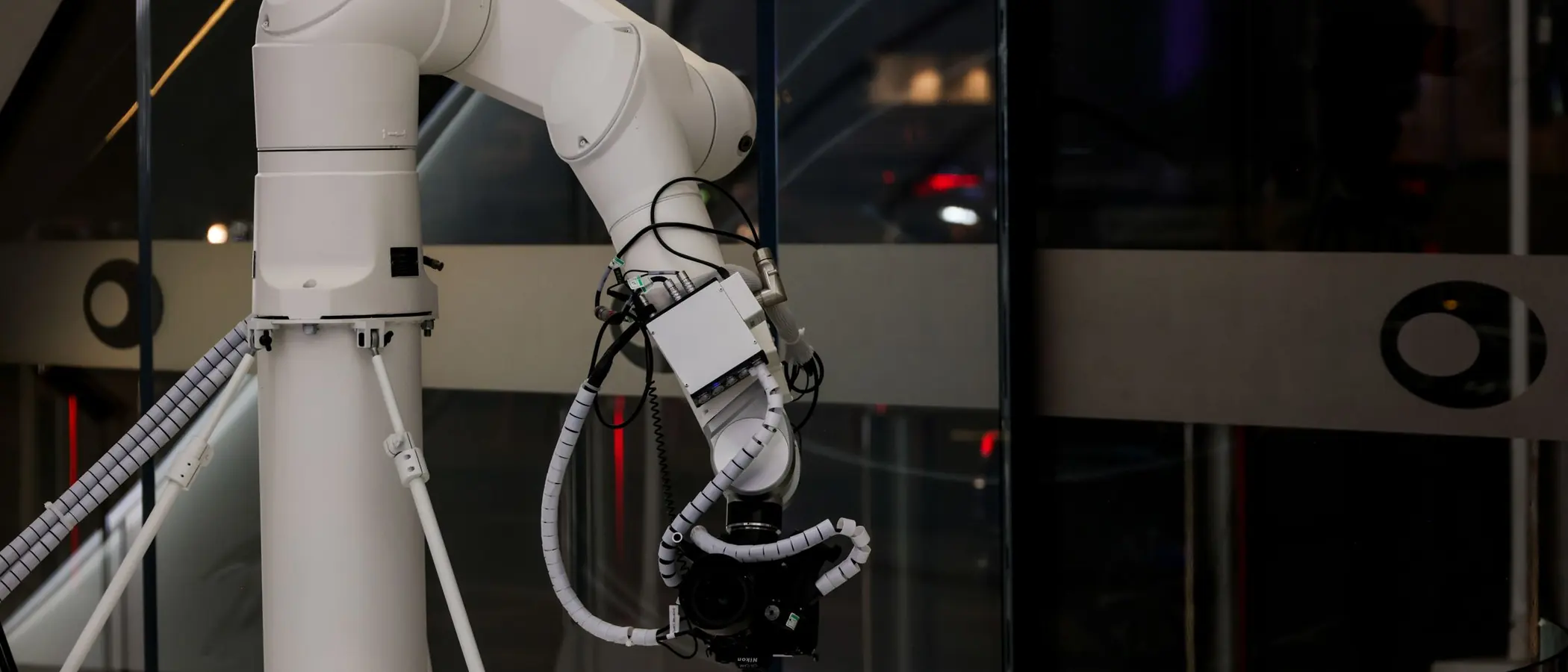
The revolution in manufacturing processes in Industry 4.0 is based on a shift in the industrial paradigm, from a focus on reactive problem-solving to the proactive implementation of machines, processes, and products combined with hybrid technologies.
From improving operational efficiency and managing the supply chain to planning better conditions for operational teams, machine learning and industrial automation can open new paths for business. Keep reading to learn more about the AI revolution in industry.
The benefits of AI in production line automation
Keeping a factory digitally equipped with intelligent machines drives the evolution of processes and makes companies' production performance more efficient. Check out the main benefits of AI in process automation, which enable operational improvements, fewer errors, and greater quality control and safety, ensuring end-customer satisfaction:
Increased productivity
Smart devices can improve operational execution on manufacturing lines and in product facilities, boosting productivity.
Through Machine Learning, by extracting meaningful results from real-time data, these technologies monitor and analyze production to identify where they can correct quality problems or where process performance falls short of what was intended.
Cost reduction
Using smart technologies to improve the ability to analyze factory operations allows resources to be allocated intelligently, based on more accurate forecasts of operating costs and inventories, for example.
In this way, more precise analyses make it possible to eliminate downtime costs and reduce spending on inspection and maintenance.
Safety and risk prevention
Industrial robots are able to maintain precise mobility in complex environments. They can therefore help respond immediately to the factors and circumstances that create unsafe conditions for employees in high-risk areas of companies.
With this technology, machines can monitor workers' performance in completing a task that cannot be fully automated on the production line, for example, strengthening safety and reducing the risk of potential accidents.
Decision-making support
With machine learning and sensors applied to factory management, managers can obtain more accurate insights, based on volumes of real-time data, to predict productivity trends that affect sales growth and service performance, influencing market competitiveness.
AI and data analysis for optimizing industrial processes
Data analysis in industry is fundamental in a 4.0 scenario, because it gives the company's numbers even greater significance in a Big Data context where there is a great deal of information to analyze.
By structuring good data analysis, it is possible to make far more accurate decisions, grounded in reliable information that represents the true picture of the industry.
As a result, intelligent data-based software can help companies simplify workflows through automation systems that give managers comprehensive visibility into machine operation processes and people management, for example.
In addition, real-time data analysis is another important advantage of using AI-based solutions. This is because their processing capacity provides valuable insights into business operations and identifies trends, allowing organizations to make more informed and accurate decisions.
For this reason, companies equipped with AI-based solutions are able to automate and customize the analysis of their data in real time, ensuring that information is delivered to the professionals and teams who need it at the right moment.
AI and quality control: reducing manufacturing defects
Maintaining desired levels of product quality is related to the predictability of processes based on a set of parameters that must be followed in industry for lean manufacturing.
Smart devices can help reduce manufacturing defects and reach quality targets by using algorithms to quickly detect process defects or nonconformities in the expected quality of products.
These aspects can be identified when systems issue alerts that the desired quality is being compromised in manufacturing and in the teams' internal management processes, speeding up production and identifying defects.
In addition, here the interconnectivity of software can be applied to predicting losses at different levels, such as financial losses through prior analysis of raw material prices, which is a challenge for industry.
Loss prediction can also lie in tracking the useful life condition of equipment, which can be repaired without interrupting production, at scheduled times and minimizing factory downtime.
It is also worth highlighting the ability to assess inventories, avoiding the need to overproduce or underproduce according to market or customer demand.
AI and lean manufacturing: improving operational efficiency
The use of artificial intelligence in companies has become a key element for improving operational efficiency and supporting industrial quality control.
With the complexity of business management in Industry 4.0, intelligent solutions are proving increasingly promising for optimizing processes, reducing costs, and minimizing risks.
By enabling the processing of large amounts of data in real time, AI can analyze information from multiple systems and identify areas that need improvement, allowing IT teams to spot bottlenecks and inefficient processes, improve productivity, and develop solutions that reduce the time needed to complete tasks.
In addition, 4.0 technologies are able to automate repetitive tasks, such as system monitoring, for example, which allows employees who were previously dedicated to those demands to focus on other, more complex and strategic activities.
AI-based solutions make management more agile, efficient, and adaptable to market changes and requirements, improving companies' ability to remain competitive, stay compliant with legislation, and meet customer needs with excellence.
Resilient companies tend to adapt to change with accuracy and competitiveness, and in the face of the challenges of AI in Industry 4.0, defining strategies in this regard and relying on specialist partners is the best path.
Enacom specializes in developing solutions for industry's complex problems and has been in the market since 2009. Talk to our team and advance your business's competitiveness.
Learn more: explore the Performance Digital Twin.